
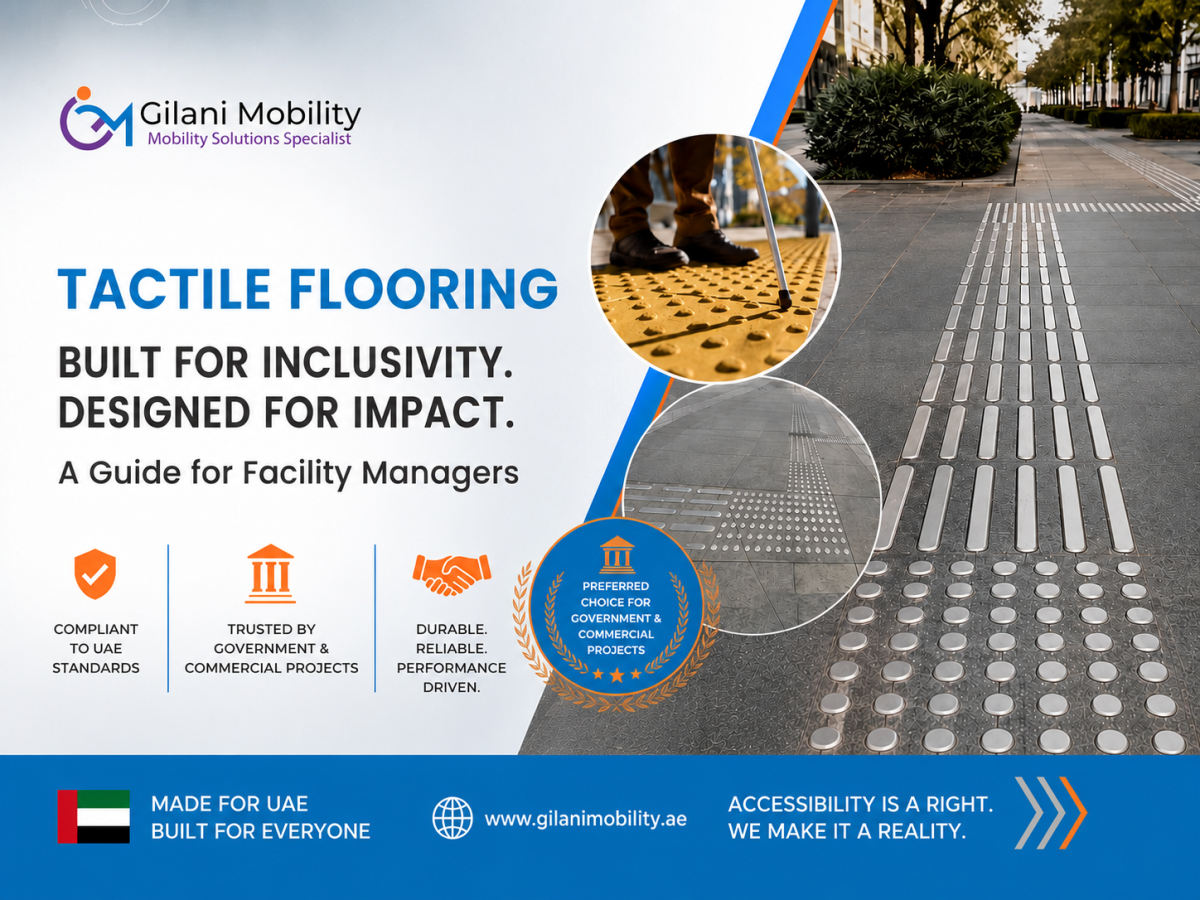
Accessibility compliance has moved from a “nice to have” to a hard requirement on almost every commercial, transport, and government tender in the UAE. Tactile indicators – the raised studs and strips that guide visually impaired pedestrians are now a standard line item in project specifications for malls, hospitals, transport hubs, and public buildings.
While there is a considerable amount of information available on tactile indicators, most of it is limited to general or introductory content. Professionals who are directly involved in the specification, procurement, design, installation, and maintenance of tactile indicators such as government authorities, municipalities, consultants, architects, main contractors, MEP consultants, procurement departments, facility management companies, and developers often do not have access to comprehensive, practical, and technically detailed information that supports informed decision-making throughout the project lifecycle.
At Gilani Mobility, we supply and install tactile indicators for commercial and government projects across the UAE, so we pulled together the questions we hear most often from procurement and facilities clients, and answered them the way we’d answer them in a project meeting no fluff.
1. Which installation method should I choose: 3M adhesive or nail-fixed?
This comes down to the substrate and the permanence you need, not personal preference.
Nail-fixed is the better choice for exterior concrete, pavement, and any high-traffic, high-load area where the fixing needs to withstand years of foot and wheel traffic, pressure washing, and weather cycling. It’s semi-permanent and the standard choice for outdoor guiding paths and transport infrastructure.
3M adhesive is suited to smooth, clean indoor surfaces – tile, vinyl, epoxy floors where drilling isn’t practical or permitted, such as leased retail units or heritage buildings. It’s rated for exterior use too, but only on smooth, well-prepared surfaces; rough or uneven ground will compromise adhesion over time.
Our general rule for clients: outdoor + rough surface = nails. Indoor + smooth surface = adhesive. For mixed environments, we recommend a site survey before finalizing the spec.
2. Are tactile indicator studs suitable for high-traffic commercial environments?
Yes, provided the material is specified correctly. Our 316 stainless steel solid tactile indicator studs are built for : malls, transport stations, hospital corridors, and airport terminals see thousands of footfalls a day, and the rough-textured surface is engineered to hold its anti-slip grip under sustained wear while resisting corrosion, UV exposure, and weathering. For lower-traffic or budget-sensitive interior zones, PVC studs offer a durable, cost-effective alternative without compromising on tactile feedback.
3. Which surfaces can they be installed on?
Both our stainless steel and PVC ranges install across concrete, tile, stone, and asphalt. The right combination of stud/strip type and fixing method depends on the surface hardness and finish — this is the first thing our team assesses on any commercial project before quoting.4. Are they suitable for both indoor and outdoor applications?
Yes. Every product in our tactile range stainless steel studs and strips, PVC studs and strips, and our tactile paving tiles is manufactured to perform indoors and outdoors, with weather and UV resistance built into the material specification rather than added as a coating.
5. Can they be supplied in bulk for commercial projects?
Yes. We regularly supply tactile indicators in volume for multi-floor buildings, transport corridors, and multi-site retail and healthcare rollouts. Bulk supply is priced and packaged for project timelines, not retail quantities.
6. Do you provide supply and installation across the UAE?
Yes, supply and installation across all seven Emirates, from single-site retrofits to multi-building rollouts.
7. Are they suitable for government and infrastructure projects?
Yes. Our tactile indicators range is designed to meet DUBAI CODE tactile ground surface indicator (TGSI) standards for visually impaired access, and we’ve supplied projects for government, transport, healthcare, and education clients, our client list includes entities such as Dubai Police, Dubai World Trade Centre, Ajman, the University of Sharjah, and government hospitals across the UAE.
8. What maintenance is required after installation?
Minimal. The stainless steel and PVC ranges are designed to be weather-resistant and easy to clean routine sweeping or pressure washing is typically sufficient. Nail-fixed installations require virtually no ongoing maintenance; adhesive installations should be periodically checked for edge lifting in high-moisture or high-traffic zones.
9. Why choose solid stainless steel tactile studs instead of hollow alternatives?
Solid studs are the stronger choice for heavy-duty, high-load, or long-term outdoor applications loading docks, vehicle-adjacent walkways, government infrastructure where maximum durability and impact resistance matter more than weight. Hollow tactile strips are engineered for a different priority: they deliver the same rough surface textured tactile feedback and stainless steel finish at a reduced weight, which makes them easier to handle and install across long guiding paths without sacrificing compliance or corrosion resistance. The right choice isn’t “better vs worse” it’s matching the product to the load and traffic profile of the specific zone.
10. Do you provide technical support and project consultation?
Yes. Beyond supply, our team advises on product selection, layout, and installation method based on your surface type, project standard, and budget from a single reception entrance to a full facility rollout.
The bottom line for specifiers and procurement teams
Tactile indicators are a compliance product, but they’re also a safety product – the margin for error is small. Getting the material grade, fixing method, and layout right the first time avoids costly retrofits and keeps projects moving through inspection and handover without delays.
If you’re specifying tactile indicators for an upcoming project – mall, hospital, transport hub, school, or government facility – we’re happy to review your drawings and recommend the right combination of product and installation method.
📩 sales@gilanimobility.ae | 📞 +971 4 881 8426