
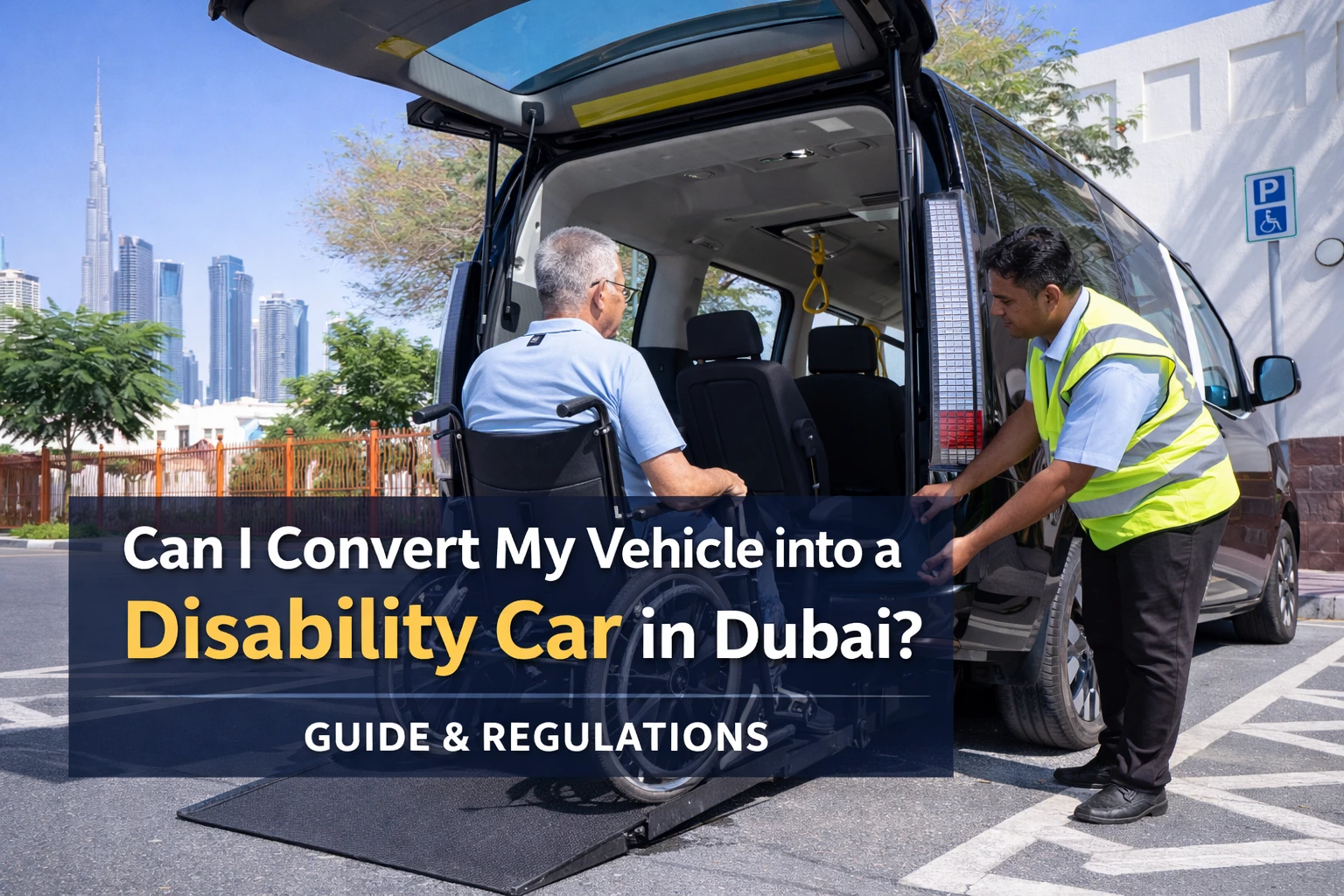
Can I Modify My Vehicle for Wheelchair Access in Dubai?
Yes, many vehicles can be modified to improve wheelchair access, passenger transfer or adapted driving — but not every vehicle is suitable for every type of conversion.
The right solution depends on the vehicle make and model, available interior space, door openings, floor structure, wheelchair dimensions, whether the person transfers to a vehicle seat or remains seated in the wheelchair, and how the vehicle will normally be used.
A person who can transfer from a wheelchair into a vehicle seat may only need a swivel seat, transfer solution or wheelchair hoist. A passenger who needs to remain seated in the wheelchair during travel may require a more substantial wheelchair-accessible vehicle conversion.
This guide explains what can be modified, what should be measured before choosing equipment, and what vehicle owners in Dubai and across the UAE should consider before starting a project.
If you are looking for available modification products and installation services, explore Gilani Mobility’s
vehicle modification and adaptive driving solutions in Dubai and the UAE
.
Quick Answer: Can My Existing Car Be Made Wheelchair Accessible?
Possibly. Many cars, MPVs and vans can be adapted, but the phrase “wheelchair accessible” can describe several very different requirements.
First determine whether the user:
- transfers from the wheelchair into a conventional vehicle seat;
- remains seated in the wheelchair as a passenger;
- drives the vehicle and requires adapted driving controls; or
- only needs the wheelchair or mobility device loaded into the vehicle.
These situations can require very different equipment and levels of modification.
A full wheelchair-passenger conversion generally requires considerably more assessment than installing a swivel seat, wheelchair hoist or driving control. The vehicle and user’s requirements should therefore be assessed before buying equipment or committing to structural work.
What Is a Vehicle Accessibility Modification?
A vehicle accessibility modification changes or adds equipment to make entering, travelling in or driving a vehicle easier for a person with mobility requirements.
The modification does not always mean converting the entire vehicle into a wheelchair-accessible car. Some users only require help transferring into a conventional vehicle seat, loading a wheelchair or operating the vehicle controls.
Vehicle accessibility solutions can therefore range from relatively compact adaptations to substantial wheelchair-passenger conversions.
| User Requirement | Possible Solution to Assess |
|---|---|
| Easier transfer into a vehicle seat | Swivel or transfer seat |
| Load a wheelchair into the vehicle | Wheelchair or boot hoist |
| Enter while remaining in the wheelchair | Ramp, wheelchair lift or lowered-floor access |
| Travel while remaining in the wheelchair | Wheelchair-passenger conversion with appropriate securement and restraint |
| Drive with reduced lower-limb function | Hand controls or adapted accelerator |
| Easier steering | Steering aid |
| Reduced effort opening vehicle access | Automatic door or tailgate system |
What Types of Vehicle Modifications Are Available?
1. Swivel and Transfer Seats
A swivel or transfer seat may be appropriate when a wheelchair user can transfer into a conventional vehicle seat but finds standard vehicle entry difficult.
This can be a less extensive solution than converting the vehicle so the passenger remains seated in the wheelchair.
Learn more about Gilani Mobility’s
Turny swivel and transfer car-seat solutions
.
2. Wheelchair Lifts
A vehicle wheelchair lift raises and lowers a wheelchair between ground level and the vehicle floor.
Before selecting a lift, assess:
- wheelchair overall width and length;
- combined wheelchair and user weight;
- lift platform dimensions;
- available installation space;
- vehicle door opening; and
- compatibility with the proposed vehicle.
A lift should not be selected based on weight capacity alone. Platform size, entry clearance and compatibility with the wheelchair and vehicle are equally important.
Explore
wheelchair lifts for vans and accessible vehicles
.
3. Wheelchair Ramps
A wheelchair ramp can create a boarding route between ground level and a suitable vehicle.
Ramp suitability depends on the vehicle floor height, usable entry dimensions, wheelchair dimensions, available deployment space and proposed wheelchair passenger position.
Rear-entry ramps may require suitable space behind the vehicle when deployed. This can be important in villa driveways, underground parking, hospitals, hotels, shopping centres and other restricted parking environments.
For a dedicated ramp-based conversion example, see Gilani Mobility’s
Easy Pull Ramp wheelchair van conversion guide
.
4. Lowered-Floor and NoRamp® Access
Some vehicle conversions use a lowered internal floor to create additional wheelchair-entry and passenger clearance.
Gilani Mobility’s
G24 NoRamp® wheelchair vehicle conversion
is an example of a conversion approach that provides wheelchair access without relying on a conventional long external ramp behind the vehicle.
This type of system may be worth assessing when external ramp-deployment space is an important consideration.
5. Adaptive Driving Controls
Not every accessibility modification is designed for a wheelchair passenger. Some People of Determination drive independently but require adapted vehicle controls.
Depending on the driver and vehicle, options can include:
- hand controls;
- left-foot accelerators;
- steering aids; and
- other adapted driving equipment.
Driver adaptations should be selected around the individual driver’s requirements and the specific vehicle.
See Gilani Mobility’s
adaptive driving and vehicle modification solutions
for related options.
Wheelchair Securement and Occupant Restraint Are Different
If a passenger remains seated in a wheelchair during travel, two separate issues should be considered.
1. Wheelchair securement: how the wheelchair is secured in the travelling position.
2. Occupant restraint: how the passenger travelling in the wheelchair position is appropriately restrained.
Securing the wheelchair does not itself provide passenger restraint, and placing an occupant-restraint system around the passenger does not itself secure the wheelchair.
The wheelchair position, wheelchair securement and occupant-restraint arrangement should therefore be considered together during conversion assessment and final vehicle handover.
For further guidance, read our
UAE wheelchair vehicle conversion handover guide
.
How Do I Know Whether My Current Vehicle Is Suitable for Modification?
Vehicle suitability should be assessed individually. A larger vehicle is not automatically suitable, and a smaller vehicle is not automatically unsuitable.
Before planning a conversion, consider the following.
1. Vehicle Make, Model and Year
Accessibility equipment and structural conversion systems can be vehicle-specific. The exact vehicle specification should be checked before selecting equipment.
2. Door Opening and Entry Clearance
Measure the usable opening rather than relying only on the external dimensions of the vehicle.
3. Interior Height
Internal clearance becomes especially important when the passenger remains seated in a wheelchair during entry and travel.
4. Vehicle Floor and Structure
Some substantial wheelchair conversions involve changes to the floor, seating layout or internal structure. Not every vehicle is suitable for the same type of modification.
5. Wheelchair Dimensions
Useful measurements can include:
- wheelchair overall width;
- wheelchair overall length;
- occupied wheelchair height with the user seated normally; and
- combined wheelchair and user weight where relevant to equipment selection.
6. Wheelchair Passenger Position
Determine where the wheelchair passenger needs to travel and how much passenger seating needs to remain after modification.
7. Everyday Vehicle Use
Consider where the vehicle will normally be used, including:
- home or apartment parking;
- underground car parks;
- hospital and clinic visits;
- school or workplace journeys;
- caregiver access;
- airport journeys; and
- long-distance travel between Emirates.
Do You Need an Adaptation or a Full Wheelchair Vehicle Conversion?
| Situation | Solution Usually Worth Assessing |
|---|---|
| User transfers into the vehicle seat | Swivel or transfer seat |
| Wheelchair only needs to be loaded | Boot or wheelchair hoist |
| Wheelchair user requires powered boarding | Vehicle wheelchair lift |
| Passenger remains in wheelchair during travel | Full wheelchair-passenger conversion |
| Long external ramp is impractical | Lowered-floor or alternative access system |
| Driver requires adapted vehicle controls | Hand controls, steering aid or accelerator adaptation |
A full wheelchair-accessible vehicle conversion should not automatically be recommended when a simpler modification can meet the user’s actual requirements.
What If My Current Vehicle Is Not Suitable for a Full Wheelchair Conversion?
Sometimes an existing vehicle does not provide enough entry clearance, internal wheelchair space or suitable structural compatibility for the required conversion.
In that situation, it may be more practical to assess another vehicle platform rather than forcing an unsuitable conversion.
If you need to compare vehicles already designed or converted around wheelchair access, explore Gilani Mobility’s
wheelchair accessible vehicles for sale in Dubai and the UAE
.
This is the better route when the requirement is to purchase or compare a complete wheelchair-accessible vehicle rather than modify the vehicle you already own.
Examples of Vehicle Platforms Used for Wheelchair Conversion
Depending on the required access system, vehicle platforms such as the Hyundai Staria and Kia Carnival can be assessed for wheelchair-accessible conversion.
However, neither vehicle should be selected purely because it appears spacious. The wheelchair dimensions, occupied height, passenger position, access method and required seating should be considered first.
For model-specific information, see:
Hyundai Staria wheelchair conversion in Dubai and the UAE
Kia Carnival wheelchair-accessible vehicle conversion
If you want to compare several accessible vehicle platforms instead of one specific model, read our
wheelchair accessible vehicle comparison guide
.
Do Vehicle Modifications Need Inspection or Documentation in Dubai?
Vehicle-modification requirements can vary according to the vehicle, type of modification and registration circumstances.
A swivel seat, driving control, wheelchair lift and substantial structural floor conversion should not automatically be assumed to follow exactly the same technical or documentation process.
Before proceeding, ask what inspection, technical documentation or registration requirements may apply to the specific vehicle and proposed modification.
For vehicles registered in Dubai, owners can also refer to the official
Roads and Transport Authority (RTA)
for current vehicle inspection and registration information.
After installation, keep the relevant conversion documents, equipment information and technical records supplied with the project.
Our
post-conversion wheelchair vehicle guide for the UAE
explains additional handover and ownership considerations.
How Vehicle Accessibility Can Support People of Determination
Accessible vehicle modifications can help some People of Determination reduce physical barriers when entering, travelling in or driving a vehicle.
Depending on the individual and modification, this may support:
- travel to work or education;
- healthcare appointments;
- family journeys;
- community participation;
- independent driving where appropriate; and
- easier passenger transfer.
The most useful modification is the one that addresses the person’s actual mobility and travel requirements rather than simply adding the greatest number of accessibility products.
What Happens During a Vehicle Modification Assessment?
Step 1 — Explain the User’s Mobility Requirement
Identify whether the main goal is wheelchair entry, passenger transfer, adapted driving, wheelchair loading or a combination of requirements.
Step 2 — Provide the Vehicle Details
Provide the vehicle make, model, model year and information about how the vehicle is normally used.
Step 3 — Measure the Wheelchair Where Relevant
For wheelchair-access projects, measurements may include width, length, occupied height and weight information.
Step 4 — Assess Vehicle Compatibility
The vehicle’s entry opening, internal space, floor, seating configuration and installation requirements should be considered.
Step 5 — Compare Suitable Accessibility Solutions
Depending on the user and vehicle, the options may include a ramp, wheelchair lift, transfer seat, driving control, lowered-floor conversion or another accessibility system.
Step 6 — Confirm Installation and Project Requirements
Confirm the selected equipment, installation requirements, relevant documentation and current project timeline before proceeding.
Step 7 — Technical Handover
After installation, the user or caregiver should understand how the installed accessibility equipment is intended to operate and what inspection, servicing or maintenance may be required.
Gilani Engineering Insight: Start With the User, Not the Product
A common mistake is choosing an accessibility product before confirming whether it suits the vehicle and the person who will use it.
For example, selecting a wheelchair ramp without checking entry height and deployment space, or choosing a vehicle based only on exterior size without checking occupied wheelchair height, can result in a configuration that does not work well in everyday use.
A better assessment sequence is:
Person → Wheelchair → Travel Requirement → Vehicle → Accessibility System
rather than:
Product → Vehicle → User
Learn more about
Ray Gilani, Founder of Gilani Mobility and Mechanical & Automotive Engineer
,
whose work includes wheelchair-accessible vehicles, adaptive driving systems and vehicle modifications.
See Real Vehicle Accessibility Projects
Completed projects can help customers understand how accessibility equipment is integrated into real vehicles rather than relying only on product illustrations or manufacturer images.
Review Gilani Mobility’s
vehicle modification and wheelchair accessibility projects
for examples of completed work.
Watch Vehicle Modification Demonstrations
Video demonstrations can help users understand how wheelchair entry systems, lifts, transfer equipment and other accessibility modifications operate in practice.
Visit the
Gilani Mobility vehicle accessibility video guides and demonstrations
.
Warranty, Servicing and After-Sales Questions to Ask
Before confirming a vehicle modification, ask:
- What installed equipment is covered by warranty?
- Does the installation or workmanship have separate terms?
- Who provides servicing and technical support?
- Are replacement parts available locally?
- How often should powered equipment be inspected?
- Who should be contacted if the accessibility system stops operating?
Warranty coverage can vary by product and project, so the terms applicable to the specific vehicle modification should be confirmed before ordering.
You can also review Gilani Mobility’s
warranty and after-sales support information
.
Vehicle Accessibility Support in Dubai & Across the UAE
Gilani Mobility provides vehicle accessibility solutions including wheelchair access, passenger-transfer solutions and adaptive driving equipment.
Customers can discuss their mobility requirements and vehicle details before a modification is selected so that the proposed equipment can be assessed against the actual vehicle and intended use.
For the complete commercial range, visit our
vehicle modification solutions in Dubai and the UAE
.
Frequently Asked Questions About Vehicle Modification for Wheelchair Access
Can every car be converted for wheelchair access?
No. Suitability depends on the vehicle structure, available entry clearance, internal space, wheelchair dimensions, passenger position and type of modification required.
Can I modify the car I already own?
Possibly. Start with the vehicle make, model and year, then assess the user’s mobility requirements and wheelchair dimensions where relevant before selecting equipment.
Do I need a full wheelchair-accessible vehicle conversion?
Not always. If the user can transfer into a vehicle seat, a swivel or transfer-seat solution may be more appropriate. A full wheelchair-passenger conversion is generally more relevant when the passenger needs to remain seated in the wheelchair during travel.
What wheelchair measurements should I take?
Useful measurements include overall wheelchair width, overall length and occupied wheelchair height. Combined wheelchair and user weight may also be required when selecting equipment with specific capacity limits.
Is a wheelchair ramp or wheelchair lift better?
Neither is universally better. The choice depends on the vehicle floor height, wheelchair dimensions, user requirements, available installation space and normal boarding environment.
Can a Hyundai Staria be modified for wheelchair access?
Selected Hyundai Staria configurations can be assessed for wheelchair access. See our
Hyundai Staria wheelchair conversion guide
for model-specific options.
Can a Kia Carnival be converted for wheelchair access?
Selected Kia Carnival configurations can be assessed for wheelchair accessibility. Suitability depends on the wheelchair, vehicle specification, access method and required passenger layout.
See our
Kia Carnival wheelchair accessible vehicle guide
.
Do modified vehicles need inspection in Dubai?
Requirements depend on the vehicle and type of modification. Owners should confirm the inspection, documentation and registration requirements that apply to their specific vehicle and proposed modification.
What happens after a wheelchair vehicle conversion?
The owner should receive a functional handover, keep relevant project documentation and understand the operation, inspection and servicing requirements of the installed accessibility equipment.
What if my current vehicle cannot be converted?
Another vehicle platform may be more practical. In that situation, compare suitable wheelchair-accessible vehicle options rather than forcing an unsuitable modification onto the existing vehicle.
Technical Review & Accessibility Expertise
This guide is intended to help wheelchair users, People of Determination, families, caregivers and vehicle owners understand the questions that should be considered before modifying a vehicle for accessibility.
Technical review:
Ray Gilani
,
Founder of Gilani Mobility and Mechanical & Automotive Engineer.
Vehicle modification decisions should ultimately be based on the specific user, wheelchair where applicable, vehicle and intended use.
Last updated: September 2026
Need to Know Whether Your Vehicle Can Be Modified?
Before buying a ramp, wheelchair lift, transfer seat or full conversion, have the vehicle and user requirements assessed together.
When contacting Gilani Mobility, provide where possible:
- vehicle make;
- vehicle model;
- model year;
- photos of the vehicle where useful;
- wheelchair make and model if applicable;
- wheelchair width, length and occupied height;
- whether the user transfers to a vehicle seat or remains in the wheelchair; and
- number of passengers required.
This information can help determine which accessibility options are worth assessing.
Request a Vehicle Compatibility Assessment
Explore Vehicle Modification Solutions
If you are looking for a complete accessible vehicle rather than modifying your existing car, explore our
wheelchair accessible vehicles for sale in Dubai and the UAE
.
Call Gilani Mobility:
+971 4 881 8426