
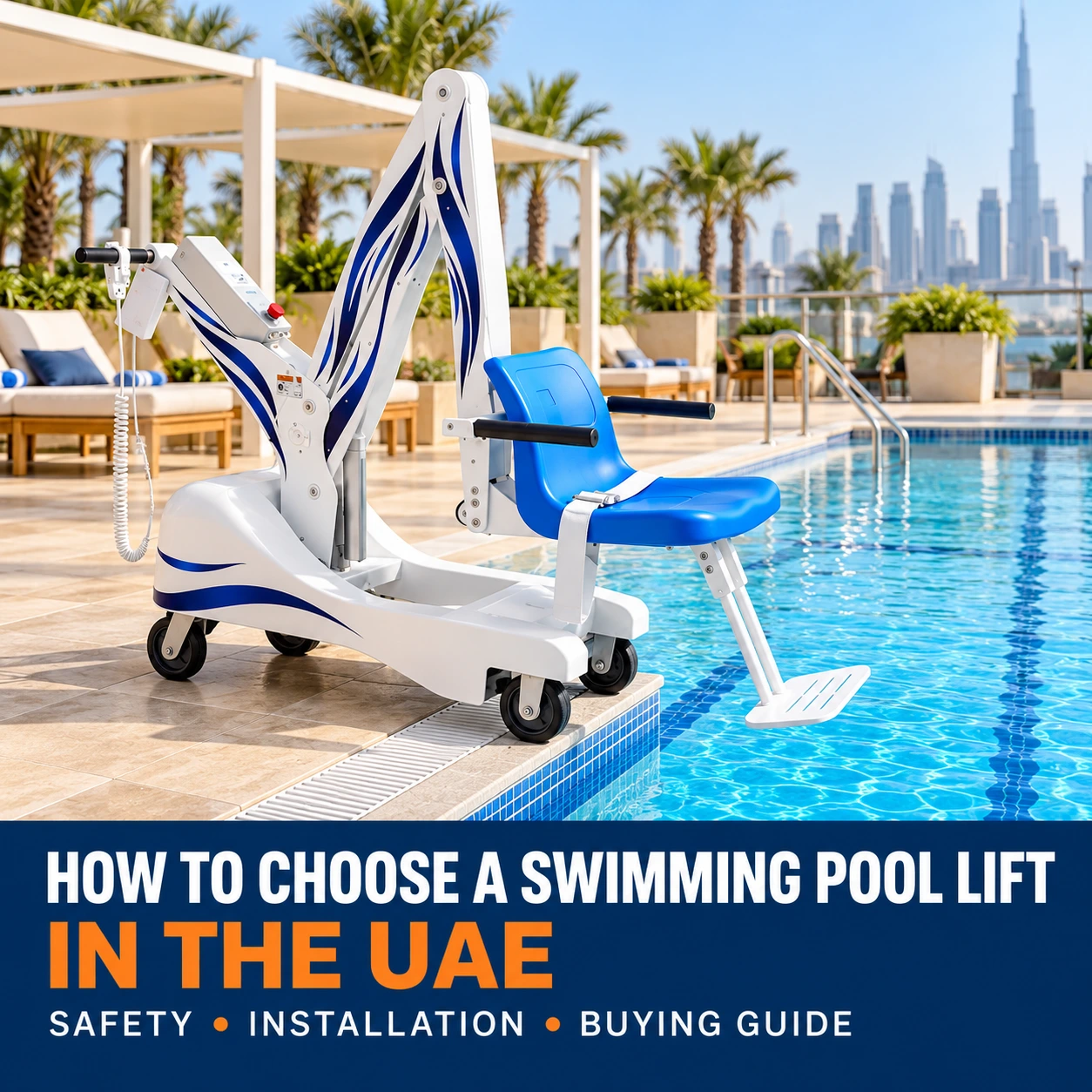
Swimming pools should be accessible and enjoyable for everyone. However, for wheelchair users, older adults and people with limited mobility, entering or leaving a swimming pool can be challenging when the only access options are steps or ladders.
A swimming pool lift, also known as a pool hoist, helps people with reduced mobility transfer between the poolside and the water. These accessibility devices are used in private villas, hotels, resorts, rehabilitation centres and other swimming facilities across Dubai and the UAE.
Choosing the right swimming pool lift involves more than comparing portable and fixed models. You need to consider the user’s mobility and transfer requirements, poolside space, weight capacity, installation conditions, safety features and ongoing maintenance.
This guide explains how to choose a swimming pool lift in the UAE, the differences between pool lift types, important buying considerations, Dubai accessibility guidance and the practical steps involved in selecting suitable equipment.
Quick Answer: Which Swimming Pool Lift Should You Choose?
The best swimming pool lift depends on the user’s transfer needs, the swimming pool layout, available deck space and how frequently the equipment will be used.
A portable swimming pool lift may be appropriate when permanent installation is undesirable or the equipment needs to be repositioned. A fixed pool lift can be suitable for facilities requiring a permanent, dedicated accessible entry point.
Motorised portable models may also be considered where powered movement can reduce the physical effort required to reposition equipment.
Before purchasing, confirm the maximum lifting capacity, seat support, required assistance, pool-edge dimensions, water level and installation requirements. A poolside assessment can help identify the most suitable solution.
For available equipment, explore the swimming pool lifts and pool hoists in Dubai and the UAE offered by Gilani Mobility.
What Is a Swimming Pool Lift and How Does It Work?
A swimming pool lift is a mechanical accessibility device designed to assist a person with reduced mobility in transferring between the swimming pool deck and the water.
Most conventional swimming pool lifts include a supportive seat, lifting arm, operating controls and a powered lifting mechanism. Depending on the model, the equipment can raise, rotate or lower a user in a controlled movement.
Some pool lifts allow suitable users to operate the controls independently, while others require assistance from a trained caregiver or attendant.
How Does a Swimming Pool Lift Transfer Work?
Step 1 – Equipment preparation: The lift is checked and positioned according to the manufacturer’s instructions. The operating area must be clear, and the appropriate safety procedures should be followed.
Step 2 – User transfer: The person transfers from their wheelchair or mobility aid onto the pool-lift seat. Depending on their mobility, assistance may be required.
Step 3 – Seating and positioning: The user’s position is checked, and any required seating supports or restraints are used according to the equipment instructions.
Step 4 – Lowering into the water: The lift moves the seated user toward and into the swimming pool using its designated operating controls.
Step 5 – Returning to the deck: After swimming, the lift is used to return the person to a suitable poolside transfer position.
Important: Most standard seated swimming pool lifts do not lower a person’s everyday wheelchair into the water. The user generally transfers onto the dedicated lift seat before entering the pool.
Who Can Benefit from a Swimming Pool Lift?
Wheelchair users: A suitable pool lift can provide an alternative to traditional pool steps or ladders for people who cannot use them comfortably.
Older adults: People with age-related mobility difficulties may benefit from assisted pool entry, depending on their balance and transfer needs.
People with physical disabilities: Swimming pool lifts can support access for individuals with reduced mobility who require an appropriate transfer solution.
Rehabilitation patients: Pool access equipment may be used in facilities offering suitable aquatic activities or rehabilitation programmes.
Hotels and community facilities: Accessible pool entry solutions can help accommodate guests and residents with different mobility requirements.
The suitability of any pool lift should be assessed for the individual user rather than assuming one design works for everyone.
Portable vs Fixed Swimming Pool Lifts: What’s the Difference?
Portable and fixed swimming pool lifts serve similar purposes, but their installation methods, operating requirements and practical applications are different.
Portable Swimming Pool Lifts
A portable swimming pool lift is designed to be repositioned according to the manufacturer’s instructions. Selected models do not require permanent fixing to the swimming pool deck.
Portable pool lifts may be suitable for private villas, hotels, rehabilitation facilities and other locations where a permanently installed lift is not preferred.
However, portable equipment is not necessarily lightweight. Some models have substantial equipment weight and require suitable operating surfaces, braking systems, stabilisation and careful repositioning.
For example, the Monaco P150 Portable Pool Lift is manufactured by Gilani Mobility in the UAE. It has a stated maximum lifting capacity of 150 kg and does not require permanent pool-deck fixing.
The Monaco P150 features a rechargeable 24V battery, emergency stop control, seating support and components designed for wet operating environments. Its suitability still depends on the user and pool layout.
Fixed Swimming Pool Lifts
A fixed swimming pool lift is installed at a designated position beside the pool. It can be useful where accessible entry is required regularly at the same location.
Fixed lifts may be considered for hotels, rehabilitation centres, community pools and other swimming facilities that can accommodate an appropriate permanent installation.
Before installation, the mounting structure, pool-edge configuration, water level, deck accessibility and available transfer space need to be assessed.
The InPool Fixed Pool Lift is one example of a permanently installed pool-access solution, with a stated maximum lifting capacity of 140 kg.
Portable vs Fixed Pool Lift Comparison
| Feature | Portable Pool Lift | Fixed Pool Lift |
|---|---|---|
| Installation | Some models require no permanent floor fixing | Requires a suitable permanent mounting position |
| Movement | Can be repositioned according to the model | Remains at a dedicated location |
| Storage | May be moved away when not required | Normally remains beside the pool |
| Poolside space | Requires positioning and manoeuvring space | Requires mounting and transfer clearance |
| Common settings | Villas, flexible pool areas and selected commercial facilities | Dedicated accessible pool-entry points |
| Main consideration | Stable positioning and safe movement | Structural compatibility and installation |
Which option is better? Neither design is automatically safer or more suitable. The best choice depends on the user’s transfer requirements, the pool environment and the specific equipment.
8 Important Things to Check Before Buying a Swimming Pool Lift
1. Understand the User’s Transfer Requirements
The first consideration should be the person who will use the equipment.
Determine whether the user can transfer independently, needs caregiver assistance, requires extra seating support or has difficulty maintaining a stable seated position.
Where transfers are complex, an occupational therapist or appropriately qualified rehabilitation professional may be able to help assess suitable transfer methods and positioning requirements.
The goal is not simply to lower someone into a swimming pool. It is to provide an appropriate, comfortable and dignified entry and exit process.
2. Check the Maximum Lifting Capacity
Every swimming pool lift has a manufacturer-specified maximum lifting capacity. The equipment must safely accommodate the intended user and any relevant supported accessories.
Different Gilani Mobility models have published capacities ranging from 120 kg to 150 kg, although other products and capacities may be available.
A higher lifting capacity does not automatically mean a particular model is better for every user. Seating, positioning, movement range and transfer compatibility are equally important.
Always verify the current manufacturer’s specifications before purchasing.
3. Measure the Available Poolside Space
Swimming pool lifts require sufficient space for approaching, transferring and operating the equipment.
For wheelchair users, the route leading to the lift is as important as the lift itself.
Wheelchair access: The route to the proposed lift position should be accessible and free from unnecessary obstacles.
Transfer space: There should be appropriate room for positioning a wheelchair beside the lift seat.
Caregiver space: Additional space may be necessary when an attendant assists with transfers.
Operating surface: The deck must be suitable for the selected model’s positioning, mounting and stability requirements.
Obstructions: Pool furniture, landscaping, drains and other equipment should not interfere with safe operation.
Commercial projects should also confirm the relevant accessibility clearances during design and installation planning.
4. Examine the Pool Edge and Water Level
Swimming pools differ in edge design, water depth, coping, overflow channels and the height of the water surface relative to the surrounding deck.
These details affect the position and operating movement of a pool lift.
The selected lift must provide sufficient movement for the seat to reach the required position in the water and return to a suitable transfer height at the poolside.
Raised pool edges and unusual pool designs may require a more detailed site assessment.
5. Consider How Frequently the Lift Will Be Used
A pool lift used occasionally at a private villa may have different operating requirements from equipment used throughout the day at a hotel or rehabilitation centre.
Facilities with frequent use should pay particular attention to battery capacity, charging, staff training, inspection procedures, cleaning and replacement-parts availability.
Commercial users should also consider how the lift will remain available and ready for use during operating hours.
6. Review Safety Features and Operating Controls
Swimming pool lifts may include safety belts, armrests, footrests, emergency stops, accessible controls, braking systems and alternative recovery procedures.
However, the exact features vary by model.
Ask the supplier to demonstrate how the equipment operates and explain the appropriate emergency procedure if the normal powered mechanism becomes unavailable.
Do not assume that every battery-powered pool lift includes the same emergency operating systems.
7. Consider the UAE Climate and Pool Environment
Outdoor swimming pool equipment in Dubai and other UAE locations may be exposed to strong sunlight, heat, humidity, moisture and swimming-pool treatment chemicals.
These conditions make material selection and maintenance important.
Check the manufacturer’s instructions regarding corrosion resistance, cleaning, battery storage, operating temperatures, weather exposure and compatibility with the pool-water treatment system.
Even equipment manufactured using stainless-steel components and protective coatings requires appropriate inspection and maintenance.
8. Confirm Installation, Warranty and Maintenance Support
Before purchasing a swimming pool lift, clarify exactly what is included in the supplier’s quotation.
Delivery: Confirm delivery arrangements and any additional charges for your location.
Installation: Determine whether the model requires permanent mounting, commissioning or other preparation.
Training: Ask whether operating guidance is available for the user, caregivers or facility staff.
Warranty: Check the current warranty terms, exclusions and coverage for the specific model.
Maintenance: Confirm the recommended inspection schedule and the availability of technical support and replacement parts.
Comparing the complete ownership requirements provides a more useful picture than looking at the initial equipment price alone.
Swimming Pool Accessibility Requirements in Dubai
Swimming-pool accessibility is an important consideration when planning public and commercial facilities in Dubai.
The Dubai Universal Design Code, Section 7.14, addresses swimming pools and other public-use bathing pools.
It describes accessible means of entering the water and accessible routes linking the pool with facilities and common areas.
Where an accessible entrance cannot otherwise be provided, the code discusses the use of a ramp, assisted elevation chair or hoist.
The code also addresses relevant provisions for certain private-use swimming pools, including condominium settings where an accessible provision is required by a tenant.
For the applicable text, refer to the Dubai Universal Design Code – official government-hosted document, particularly Section 7.14.
Does Installing a Pool Lift Make a Swimming Pool Fully Accessible?
Not necessarily. A swimming pool lift is one part of an accessible swimming environment.
Additional considerations can include an accessible route to the pool, suitable circulation space, changing facilities, transfer areas and relevant safety arrangements.
For an additional international technical reference, the 2010 ADA Standards for Accessible Design, Section 1009, provide detailed information on pool-lift features such as seat location, clear deck space, controls and lifting capacity.
Important: ADA requirements apply within their relevant United States legal context and should not be presented as UAE regulations.
For commercial facilities in Dubai and elsewhere in the UAE, confirm the currently applicable requirements with the relevant authorities and qualified accessibility professionals before installation.
Which Pool Lift Is Suitable for Villas, Hotels and Rehabilitation Centres?
Different environments have different pool-access requirements. Understanding the setting can help narrow down the type of equipment to consider.
Swimming Pool Lifts for Private Villas
Villa owners often want a pool-access solution that fits the existing pool without unnecessary structural changes.
A compatible portable pool lift may be useful when permanent deck fixing is undesirable, provided the deck surface, pool edge and transfer space are appropriate.
Where a dedicated pool-access location is available, a fixed model may also be considered.
The decision should account for the user’s mobility, the frequency of swimming and how equipment will be stored or maintained.
Pool Lifts for Hotels and Resorts
Hotels and resorts may need to support guests with a variety of mobility requirements.
In these environments, the pool lift should be considered alongside accessible routes, staff training, equipment availability, operating procedures and scheduled maintenance.
For hotels with multiple pools, each pool should be assessed individually. A portable lift should not automatically be assumed suitable for every location.
Pool Lifts for Rehabilitation and Hydrotherapy Facilities
Rehabilitation centres may require equipment that supports frequent transfers and users with more complex positioning needs.
The facility’s clinical or rehabilitation team should participate in equipment selection when appropriate.
Accessible equipment can support entry into the water, but it does not replace clinical assessment of whether aquatic exercise or therapy is suitable for an individual.
Pool Lifts for Community Swimming Facilities
Community pools may serve people with different disabilities, ages and mobility requirements.
Accessible entry, suitable transfer space, reliable operation, trained staff and maintenance planning all contribute to a more usable swimming facility.
Swimming Pool Lift Models Available in the UAE
Gilani Mobility offers several swimming pool lift models with different operating mechanisms, weight capacities and installation requirements.
Understanding these differences can help buyers compare potential options before requesting a detailed assessment.
Swimming Pool Lift Model Comparison
| Model | Type | Maximum Capacity | Key Characteristic |
|---|---|---|---|
| Monaco P150 | Portable | 150 kg | UAE-manufactured; no permanent deck fixing |
| PandaPool | Motorised portable | 150 kg | Powered traction for movement around the pool area |
| InPool | Fixed | 140 kg | Designed for a dedicated permanent installation |
| Blue One | Portable | 120 kg | Portable design without permanent floor fixing |
Note: The capacities shown are based on published product information. Confirm current specifications, available configurations and operating requirements before purchasing.
How Should You Compare Different Pool Lift Models?
For permanent accessible entry: Consider a fixed model where a suitable mounting location can be provided.
For flexible poolside access: Compare portable models and review the operating surface, movement and stabilisation requirements.
For powered repositioning: Motorised portable models may reduce the physical effort needed to move the equipment.
For individual transfer requirements: Review the seat dimensions, support options, controls, weight capacity and assistance needed.
The model with the highest lifting capacity is not necessarily the most appropriate solution. A suitable transfer method and poolside compatibility should take priority.
How Much Does a Swimming Pool Lift Cost in the UAE?
Swimming pool lift prices in the UAE vary according to the equipment type, lifting capacity, operating system, accessories and installation requirements.
A portable swimming pool lift that requires no permanent mounting may have different installation costs from a fixed model that needs an appropriate anchoring system.
Additional considerations can include delivery, commissioning, accessories, staff training, inspection and long-term maintenance.
What Affects Swimming Pool Lift Prices?
Equipment type: Portable, fixed and motorised portable lifts may have different purchase and operating costs.
Lifting capacity: Maximum rated load and equipment construction can influence model selection and price.
Controls and support features: Seating arrangements, powered movement and optional accessories may affect the quotation.
Installation requirements: Permanent mounting, site preparation and commissioning can contribute to the overall project cost.
Maintenance and warranty: Servicing arrangements and replacement-parts requirements should be included in the ownership assessment.
For an accurate quotation, provide the supplier with information about the pool, expected users and preferred installation arrangement.
Swimming Pool Lift Safety and Maintenance
A swimming pool lift supports a person during transfer in a wet environment. Correct operation, inspection and maintenance are therefore essential.
What Should Be Checked Before Using a Pool Lift?
Equipment condition: Check for visible damage, loose parts and other signs of deterioration.
Stability: Confirm that the lift is correctly anchored or stabilised according to its design.
Seating: Check the seat, armrests, footrests and restraints where applicable.
Operating controls: Verify that the controls and relevant safety functions are working as specified.
Battery condition: For battery-powered equipment, check charging and operating readiness.
Transfer space: Ensure the required operating area is clear and any necessary assistance is available.
Always follow the manufacturer’s instructions and any facility-specific procedures. Do not operate equipment with an unresolved safety-critical defect.
How Often Should a Swimming Pool Lift Be Serviced?
Maintenance frequency depends on the manufacturer’s instructions, usage conditions and operating environment.
Cleaning, component inspection, battery care, corrosion monitoring and checking the operating mechanism may form part of routine maintenance.
Facilities with frequent use should maintain documented inspection procedures and appropriate staff training.
Safety reminder: A pool lift is a transfer aid. It does not replace swimming supervision, rescue arrangements, trained assistance or individual medical advice.
What Information Should You Provide Before Buying a Pool Lift?
Providing accurate information about the user and swimming pool can help a supplier identify potentially suitable equipment.
Location: Specify whether the pool is in Dubai, Abu Dhabi, Sharjah or another UAE emirate.
Pool setting: Explain whether the equipment is intended for a private villa, hotel, rehabilitation facility or community swimming pool.
Photographs: Provide clear images showing the pool edge, deck and proposed lift position.
Measurements: Include relevant poolside dimensions, edge height and water-level information.
User requirements: Share relevant lifting capacity, seating and transfer requirements through an appropriate private communication channel.
Frequency of use: Explain whether the equipment will be used occasionally or regularly throughout the day.
Installation preference: State whether permanent fixing is possible or a portable solution is preferred.
Environmental considerations: Include details about outdoor exposure, pool-water treatment and storage arrangements where relevant.
This information can support an initial recommendation, although a physical assessment may still be required.
Frequently Asked Questions About Swimming Pool Lifts
Can a wheelchair user enter a swimming pool using a pool lift?
Yes. A suitable pool lift can help a wheelchair user transfer between the pool deck and the water. Most seated designs require the user to transfer from their wheelchair to the lift seat first. Depending on their mobility and the equipment, assistance may be required.
Can a portable swimming pool lift be used without permanent installation?
Some portable swimming pool lifts do not require permanent floor fixing. They must still be positioned and stabilised on an appropriate surface according to the manufacturer’s instructions.
Are swimming pool lifts suitable for elderly people?
Yes. Swimming pool lifts may assist older adults who have difficulty using conventional pool steps. The appropriate equipment depends on their mobility, balance, transfer ability and seating requirements.
Can a pool lift be installed beside an existing villa swimming pool?
Potentially. Many existing swimming pools can be assessed for portable or fixed equipment. The available deck space, pool-edge design, water level and installation conditions must be evaluated before choosing a lift.
Can swimming pool lifts be used in saltwater pools?
Compatibility depends on the manufacturer’s specifications, construction materials and water-exposure requirements. Confirm that the selected model is suitable for the specific pool-water treatment system before purchase.
Do swimming pool lifts require an electricity connection beside the pool?
Many modern swimming pool lifts operate using rechargeable batteries. Charging methods and electrical requirements vary by model. Always follow the manufacturer’s electrical-safety and charging instructions.
What is the difference between a swimming pool lift and a pool wheelchair?
A swimming pool lift is designed to assist a person in transferring between the poolside and the water. A pool wheelchair is a different mobility device intended for particular wet-area or aquatic access applications. The equipment should not be considered interchangeable.
Can hotels in Dubai use portable swimming pool lifts?
Portable pool lifts may be suitable for some hotel swimming pools. The hotel must assess the pool layout, accessibility requirements, intended users, operating procedures and staff training before selecting equipment.
Does a pool lift make a swimming pool fully accessible?
Not necessarily. A fully accessible swimming environment may also require appropriate access routes, changing facilities, transfer clearances and other accessibility provisions.
Where can I buy a swimming pool lift in Dubai or the UAE?
Gilani Mobility supplies portable and fixed swimming pool lifts for various accessibility requirements across Dubai and the UAE. Buyers can compare models, review product specifications and enquire about suitable equipment for their swimming pool.
Final Recommendations: Choosing the Right Swimming Pool Lift
A swimming pool lift can help make water-based recreation and suitable aquatic activities more accessible for wheelchair users, older adults and people with reduced mobility.
However, selecting the right solution requires an understanding of the person using the equipment, the available poolside space and the operating environment.
Before buying, prioritise the user’s transfer requirements, verified lifting capacity, pool-edge compatibility, safety features, installation arrangements and maintenance needs.
For villas, hotels, rehabilitation centres and community facilities in the UAE, a suitable pool lift should form part of a wider approach to accessible swimming-pool design and operation.
Find a Suitable Swimming Pool Lift with Gilani Mobility UAE
Gilani Mobility supplies swimming pool lifts and accessibility equipment in Dubai and across the UAE, including portable pool hoists, fixed pool lifts and other mobility solutions.
Whether you are planning accessible pool entry for a private villa or evaluating equipment for a hotel or rehabilitation facility, the team can discuss available models and the information required for equipment selection.
Need help choosing a swimming pool lift? Share your pool photographs, relevant measurements and transfer requirements with the Gilani Mobility team.
Contact Gilani Mobility for Swimming Pool Lift Enquiries
Phone: +971 4 881 8426
Email: sales@gilanimobility.ae