
Last updated: September 2026
Converting a vehicle for wheelchair access is not simply an installation job.
Once a wheelchair accessible car, swivel seat, wheelchair lift, hand control, left-foot accelerator or another mobility adaptation has been installed, several things may still need attention: final technical checks, documentation, authority requirements, insurance disclosure, user training and long-term servicing.
This is particularly important when the conversion changes the vehicle’s body, floor, seating arrangement, controls or wheelchair-occupant position.
In the UAE, modified vehicles are subject to national safety requirements, while inspection and registration procedures can also depend on the emirate where the vehicle is registered.
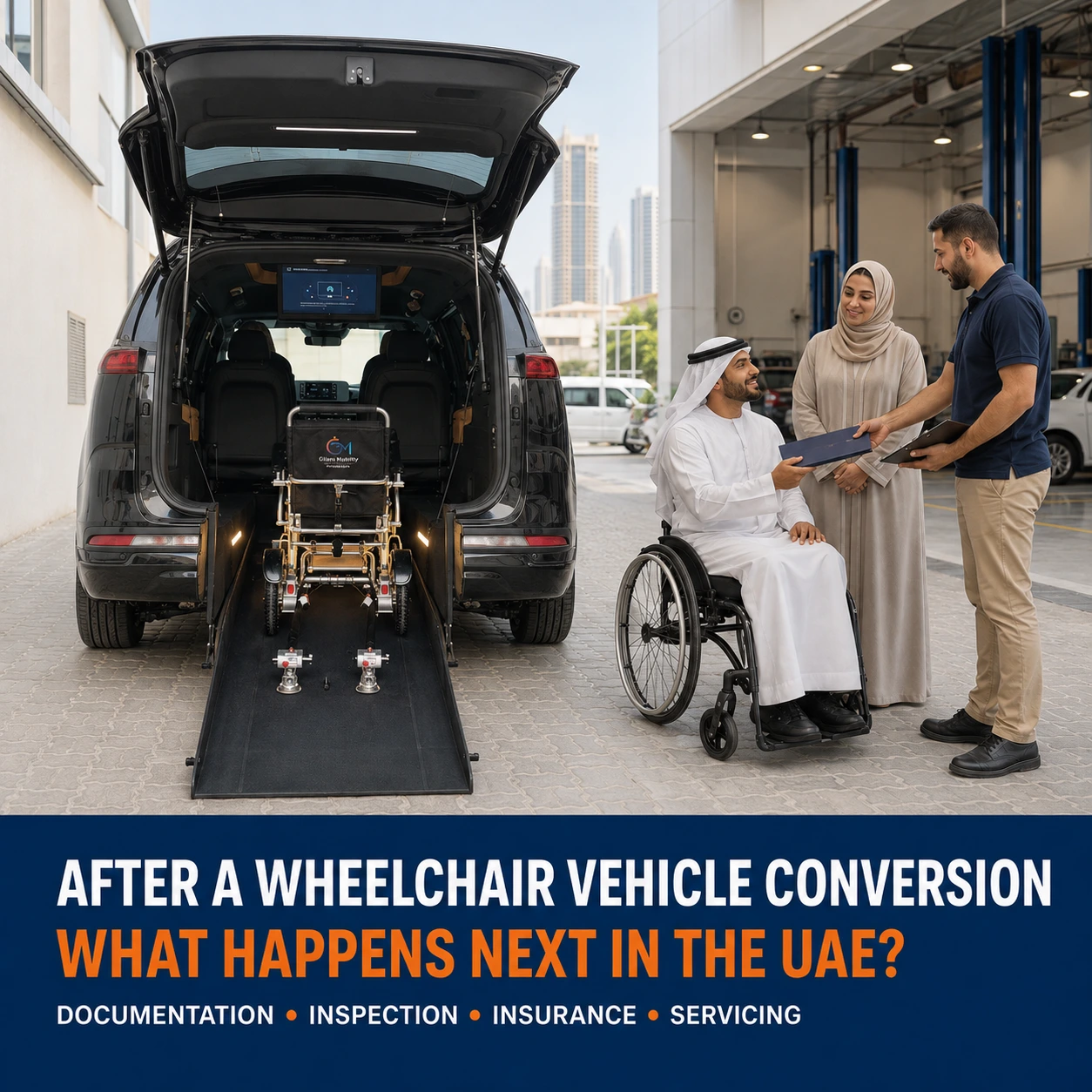
This guide explains what owners, families, drivers and organisations should consider after a wheelchair accessible vehicle conversion has been completed in the UAE, including wheelchair cars, ramp and lowered-floor conversions, swivel seats, adaptive driving controls, wheelchair lifts and other vehicle modifications for People of Determination.
Quick Answer
After a wheelchair-accessible vehicle or mobility adaptation is installed, the vehicle should go through a final technical and functional check, and the owner should keep documentation for the conversion and installed equipment.
Depending on the modification and registration emirate, additional technical inspection or authority review may be required. In Dubai, RTA states that vehicles with modified bodies may be referred to its Technical Inspection Committee, while vehicles prepared for People of Determination may also be subject to applicable testing and endorsement procedures.
The vehicle owner should also inform their motor insurer about relevant modifications and confirm how the conversion affects coverage.
Finally, an accessible vehicle should not be treated as an “install once and forget” product. Ramps, wheelchair lifts, restraint systems, powered seats, floor-lowering systems, hand controls and other mechanisms may require ongoing inspection and servicing.
In this guide
- What counts as a vehicle accessibility conversion?
- Technical handover after conversion
- Conversion documentation
- UAE approval and inspection
- Dubai and RTA considerations
- Motor insurance after modification
- Hand controls and driving adaptations
- Swivel seats vs wheelchair-accessible cars
- Wheelchair and occupant restraint
- Vehicle handover checklist
- Servicing and maintenance
- How to plan a conversion properly
- Frequently asked questions
What Counts as a Mobility or Accessibility Vehicle Conversion?
A wheelchair vehicle conversion can range from one relatively compact driving aid to a substantial structural conversion.
Gilani Mobility’s vehicle modification solutions in Dubai and across the UAE include vehicle access, wheelchair transport, transfer and adaptive-driving options.
| Modification | Main Purpose |
|---|---|
| Wheelchair-accessible vehicle conversion | Allows a wheelchair user to enter and travel inside a suitably configured vehicle. |
| Lowered-floor conversion | Creates additional wheelchair entry and interior clearance where the vehicle and conversion design permit. |
| Wheelchair ramp | Provides a boarding route for a wheelchair entering or leaving a suitable vehicle. |
| Wheelchair lift | Raises and lowers a wheelchair between ground level and vehicle floor level. |
| No-ramp access system | Provides wheelchair access without requiring a conventional external ramp to be deployed. |
| Wheelchair restraint system | Helps secure the wheelchair in an appropriate travelling position. |
| Occupant restraint system | Provides appropriate restraint for the person travelling in the wheelchair position. |
| Swivel or Turny seat | Rotates and, on selected systems, lowers a vehicle seat to make transfers easier. |
| Transfer seat | Supports movement between a wheelchair and a vehicle seating position. |
| Hand controls | Allows selected acceleration and/or braking functions to be operated by hand. |
| Left-foot accelerator | Provides an alternative accelerator position where appropriate for the assessed driver. |
| Steering aid | May assist a driver who requires an adapted steering method. |
| Wheelchair or scooter boot hoist | Helps load compatible mobility equipment into a suitable vehicle. |
| Automatic doors or tailgates | Can reduce the physical effort required to open selected vehicle access points. |
Some people still search for these solutions using expressions such as “handicap car”, “handicap vehicle conversion” or “disabled car modification”.
For clearer and more respectful terminology, Gilani Mobility generally uses wheelchair accessible vehicle, accessible car and vehicle modifications for People of Determination.
1. The Conversion Should Finish With a Technical Handover — Not Just an Installation
The first stage after installation should be a complete functional assessment.
This is particularly important for a major wheelchair accessible car conversion, because several individual systems may have to work together.
A wheelchair passenger journey may involve:
Vehicle access → interior clearance → wheelchair positioning → wheelchair securement → occupant restraint → safe exit.
A problem with any one part can affect the practicality of the whole vehicle. A final assessment should therefore consider the complete journey rather than simply checking whether a ramp, lift or seat powers on.
For a Wheelchair-Accessible Vehicle
Important checks can include:
- Usable entrance width
- Interior headroom
- Wheelchair manoeuvring space
- Access-system operation
- Floor condition and clearances
- Passenger seating arrangement
- Wheelchair travelling position
- Wheelchair securement position
- Occupant restraint arrangement
- Safe entry and exit
The wheelchair should be assessed in the position in which it will actually travel. A compact manual wheelchair and a larger powered wheelchair can require very different amounts of space.
For a Wheelchair Lift
A vehicle wheelchair lift should be checked through its complete operating cycle.
Depending on the product, checks may include the platform condition, controls, mounting arrangement, operation, safety functions and any manufacturer-provided emergency or manual procedure.
For a Swivel or Turny Seat
The complete transfer route matters.
A swivel car seat or Turny seat may rotate correctly but still be impractical if the person’s feet, knees, head or wheelchair cannot be positioned comfortably during transfer.
Vehicle door opening, seat height and surrounding clearance are therefore just as important as the swivel mechanism itself.
For Adaptive Driving Controls
Hand controls, left-foot accelerators, pedal adaptations and steering aids should be considered in the driver’s actual seating and driving position.
Reach, seating position, steering access, control movement and interaction with other vehicle functions may all need to be considered.
Gilani Engineering Insight
A successful vehicle modification is not simply one in which the equipment physically fits the car. The user, wheelchair, vehicle, access method and modification need to work together as one practical system.
2. Keep a Proper Vehicle Conversion Documentation File
Accessible-vehicle documentation can become important long after the vehicle leaves the workshop.
Owners should keep the documentation supplied with the installation rather than treating it like ordinary accessory packaging.
Depending on the conversion, useful records may include:
- Installation invoice
- Installed product make and model
- Serial numbers where applicable
- Installation information
- Manufacturer documentation
- Operating instructions
- Warranty information
- Inspection or approval documentation where applicable
- Service and maintenance records
- Photographs of the completed installation
For more substantial conversions, maintaining a clear record of what was changed and what equipment was installed can be particularly useful during future inspections, insurance renewals, servicing or resale.
For example, a vehicle containing:
wheelchair-accessible conversion + wheelchair restraint system + automatic tailgate + swivel seat + hand controls
has considerably more accessibility equipment to document and maintain than a standard production vehicle.
You should also retain any warranty information supplied with the conversion. Gilani Mobility’s general warranty and after-sales policy can be reviewed separately, while the exact warranty applicable to a vehicle product or installation should be confirmed at handover.
3. Does a Wheelchair Vehicle Conversion Need Approval in the UAE?
This is an area where vehicle owners should avoid assumptions.
The UAE has a national technical framework for modified vehicles. Cabinet Resolution No. 117 of 2024 introduced UAE.S 5014:2024 — Safety Requirements for Modified Vehicles as a mandatory UAE technical regulation, replacing the earlier 2016 standard.
You can review the official legislation through the UAE Legislation portal.
However, the precise approval or inspection pathway can depend on factors such as:
- The type of modification performed
- Whether the vehicle body or structure has changed
- Whether the vehicle was converted locally or imported already converted
- How the vehicle will be used
- Whether the modification affects driving controls
- The emirate in which the vehicle is registered
Important:
Confirm the requirements for the specific vehicle and conversion before undertaking a substantial modification. Do not assume that every modification follows exactly the same approval process.
4. What Happens With Vehicle Modifications in Dubai?
Dubai-registered vehicles fall under Roads and Transport Authority vehicle licensing and inspection procedures.
RTA states that vehicles with special characteristics, including vehicles with modified bodies, may be transferred to the Technical Inspection Committee at the Licensing Department as part of the applicable vehicle-inspection process.
You can check the latest requirements directly through the official Dubai RTA vehicle inspection information.
RTA also provides specific information relating to services for People of Determination.
This can be particularly relevant where a conversion involves a substantial change such as:
- A lowered vehicle floor
- A modified vehicle body
- A dedicated wheelchair passenger position
- A significant wheelchair-accessible conversion
- Major vehicle-access equipment
A removable mobility accessory should not automatically be assumed to follow the same pathway as a major structural conversion.
The correct process should be confirmed for the actual vehicle and modification being proposed.
5. What About Abu Dhabi, Sharjah and the Other Emirates?
Do not assume that the process for a Dubai-registered wheelchair car automatically applies unchanged throughout the UAE.
The national modified-vehicle safety framework applies across the UAE, while licensing, inspection and administrative procedures may involve the relevant authority for the vehicle’s registration emirate.
For a substantial wheelchair accessible vehicle conversion in the UAE, a sensible planning sequence is:
Identify the user → Confirm wheelchair → Identify vehicle → Define modification → Confirm registration emirate → Check applicable requirements → Complete conversion → Complete required inspection/documentation → Final handover
Trying to establish these requirements only after major work has been completed can create unnecessary complications.
6. Does the Mulkiya Need to Be Changed After a Vehicle Conversion?
There is no useful one-size-fits-all answer.
Whether vehicle registration information needs to be amended can depend on the nature of the modification and the requirements of the relevant licensing authority.
A small removable accessory and a significant vehicle-body modification are clearly not the same type of change.
For example, lowering part of a vehicle floor or substantially changing seating and wheelchair-access arrangements can have different implications from fitting a simple removable steering aid.
Key point:
Do not assume that because the vehicle already has a valid Mulkiya, every later modification is automatically covered by the existing registration. Confirm the requirement for the specific modification with the appropriate vehicle authority.
7. Tell Your Motor Insurance Company About the Conversion
This step is easy to overlook.
A wheelchair conversion may add valuable equipment and may change the vehicle from its original factory configuration.
Examples include:
- Powered wheelchair lift
- Structural floor conversion
- Wheelchair ramp system
- Powered swivel or transfer seat
- Automatic vehicle-access system
- Hand controls or other adaptive driving equipment
- Wheelchair securement equipment
Insurance treatment of modified vehicles can vary between insurers, policies and individual vehicle circumstances.
The safest approach is to tell your insurer about relevant modifications and ask for written confirmation of how the conversion is treated under your policy.
Questions to Ask Your UAE Motor Insurer
- Is the insurer aware that the vehicle has been modified?
- Is the accessibility conversion itself insured?
- What value is assigned to the installed equipment?
- Would damage to a wheelchair lift, powered ramp or swivel seat be covered?
- Does the insurer require inspection or approval documentation?
- Does the modification change the vehicle’s insured value?
- Does the modification affect the policy premium or terms?
Do not wait until an accident or claim happens to discover how the conversion is treated.
8. Driving Modifications Need Extra Attention
Passenger-access adaptations and driver adaptations solve different problems.
A wheelchair ramp helps someone access a vehicle. A hand control changes how the vehicle itself is driven.
That distinction matters.
Gilani Mobility provides adaptive driving solutions and car hand controls in Dubai and across the UAE, including options such as:
- Push-pull hand controls
- Electronic hand controls
- Left-foot accelerators
- Pedal adaptations
- Steering aids
- Secondary-control systems
Driver modifications should not be approached as ordinary decorative vehicle accessories.
The driver’s requirements, seating position and vehicle compatibility should be established, while any applicable medical, licensing or authority requirements should also be checked.
9. A Swivel Seat Does Not Turn a Car Into a Wheelchair-Accessible Vehicle
This distinction can cause confusion.
A swivel seat or Turny seat generally helps a person transfer into or out of the vehicle’s passenger seating position.
A wheelchair accessible car or wheelchair accessible vehicle is designed around providing wheelchair access into the vehicle and may, where the vehicle and system are designed for it, provide an appropriate wheelchair travelling position.
These are different mobility strategies.
| Swivel / Turny Seat | Wheelchair-Accessible Vehicle |
|---|---|
| Primarily assists transfer into a vehicle seat. | Provides a wheelchair-access route into the vehicle. |
| The user generally transfers from the wheelchair. | May allow an appropriate wheelchair travelling position, depending on the vehicle configuration. |
| Door clearance and transfer height are major considerations. | Entrance dimensions, interior clearance, wheelchair positioning and restraint are major considerations. |
A swivel seat may be worth assessing where a person can transfer from a wheelchair but finds conventional vehicle entry difficult.
A full wheelchair-accessible conversion may be more appropriate where transferring is difficult, unsuitable or unnecessary and the person requires a suitable wheelchair travelling position.
The decision should begin with the person’s real transfer and travel requirements — not simply with the product.
10. What About a Full Wheelchair Accessible Car Conversion?
A full wheelchair car conversion can involve more considerations because the wheelchair becomes part of the passenger environment.
Depending on the conversion design, the project may involve:
- Vehicle access geometry
- Floor modification
- Interior height
- Wheelchair positioning
- Passenger seating layout
- Wheelchair restraint
- Occupant restraint
- Entry and exit equipment
- Electrical, mechanical or hydraulic components
Gilani Mobility offers a range of wheelchair accessible vehicles and wheelchair car solutions in Dubai and the UAE.
One example is the G24 NoRamp® wheelchair accessible vehicle conversion, which uses an internal floor-lowering access system rather than requiring a conventional external ramp to be deployed.
The current Gilani G24 information lists selected vehicle platforms including the Hyundai Staria, Kia Carnival and Honda Odyssey, subject to compatibility and assessment.
Other wheelchair accessible vehicle solutions may use vehicle ramps, wheelchair lifts or other access systems.
One technology should not automatically be considered the best for every user.
The correct solution depends on the wheelchair, passenger, vehicle, parking environment, family requirements and intended use.
11. Wheelchair Restraint and Passenger Restraint Are Not the Same Thing
This deserves special attention after a wheelchair vehicle conversion.
Where a person travels while remaining seated in a wheelchair, two separate issues generally need to be considered:
- The wheelchair needs an appropriate securement arrangement.
- The occupant needs an appropriate passenger restraint arrangement.
Securing the wheelchair does not itself replace occupant restraint.
Likewise, placing a conventional seat belt around a wheelchair user does not by itself secure the wheelchair.
The wheelchair position, securement arrangement and occupant restraint should therefore be considered as part of the conversion assessment and final handover.
Users and caregivers should also be shown how the installed restraint equipment is intended to be operated before regular travel begins.
12. What Should You Test at Vehicle Handover?
The best time to discover that a wheelchair does not manoeuvre comfortably inside the vehicle is before the vehicle leaves the conversion facility.
Whenever practical, the final handover should involve:
the actual vehicle + the actual wheelchair + the actual user + the normal caregiver or driver.
A real-world handover can reveal issues that drawings and dimensions do not always make obvious.
Wheelchair Vehicle Handover Checklist
| Check | What to Confirm |
|---|---|
| Approach | Can the wheelchair approach the vehicle safely and conveniently? |
| Entry | Can the user enter without unnecessary head, footrest or doorway clearance problems? |
| Interior space | Can the wheelchair manoeuvre and reach the intended travelling position? |
| Restraints | Can the securement and occupant-restraint equipment be accessed and used correctly? |
| Ramp or lift | Can the normal user or caregiver operate the equipment comfortably? |
| Other passengers | Does the final configuration provide the required passenger seating? |
| Exit | Can the wheelchair leave the vehicle safely at realistic destinations? |
| Backup operation | If the manufacturer provides an emergency/manual procedure, does the user understand it? |
A wheelchair car that works perfectly inside a large workshop may behave very differently in a narrow residential or shopping-centre parking area.
13. Test Accessibility in Real UAE Parking Conditions
This is especially relevant for day-to-day travel in Dubai and other UAE cities.
A family may regularly use the vehicle at:
- Shopping malls
- Hospitals
- Schools
- Rehabilitation centres
- Apartment buildings
- Villas
- Hotels
- Airports
- Public parking areas
A rear or side external ramp requires deployment space.
A wheelchair lift requires operating clearance.
A lowered-floor system can have different vehicle and ground-clearance considerations.
A swivel seat requires sufficient room outside the vehicle door for the seat and transfer.
One of the best questions to ask before accepting a conversion:
“Will this system work where we actually park every day?”
14. Learn the Emergency Operation Before You Need It
Powered vehicle-access systems should be handed over with appropriate operating instructions.
Where the manufacturer provides a manual or emergency operating procedure, the user or caregiver should understand it.
This can apply to equipment such as:
- Powered wheelchair lifts
- Electric ramps
- Automatic doors
- Powered swivel seats
- Automated floor-lowering systems
Do not leave the operating manual unread in the glovebox.
Ask for the system to be demonstrated. If an emergency release, backup control or manual procedure is provided for that product, learn where it is located and how the manufacturer intends it to be used.
15. Wheelchair Vehicle Conversions Need Servicing Too
Vehicle accessibility equipment may contain moving, electrical, mechanical or hydraulic components.
The UAE also presents demanding environmental conditions including high temperatures, dust and sand.
Depending on the installed equipment, maintenance may involve checking:
- Moving mechanisms
- Electrical connections
- Controls
- Mounting and fixing points
- Wheelchair restraint components
- Ramp operation
- Wheelchair lift platforms
- Powered swivel seats
- Door and tailgate systems
- Floor-lowering mechanisms
- Adaptive driving equipment
The service interval should follow the requirements of the equipment manufacturer and the specific installation.
Gilani Mobility provides installation and after-sales support for selected vehicle modification and wheelchair-accessible vehicle solutions in the UAE.
16. Warning Signs That an Accessible Vehicle May Need Attention
Do not necessarily wait for complete equipment failure before arranging an inspection.
Changes in the way accessibility equipment operates can be worth investigating.
Examples may include:
- A ramp no longer sitting or operating as expected
- A powered seat moving differently or more slowly than usual
- Intermittent controls
- A wheelchair lift stopping unexpectedly during operation
- Unusual vibration or movement
- Loose fittings
- Difficulty operating wheelchair securement equipment
- An automatic door behaving differently
- Unexpected warning indicators following modification work
Why it matters:
Accessibility equipment may be directly involved in how a person enters, travels in or drives the vehicle. A developing equipment problem can therefore become an accessibility problem rather than merely an inconvenience.
17. Keep a Service History for the Vehicle Conversion
Most vehicle owners retain records for conventional car servicing. An accessible vehicle deserves the same approach for its specialised equipment.
Keep records of relevant inspections, servicing, repairs and replacement parts relating to systems such as:
- Wheelchair lifts
- Powered ramps
- Floor-lowering systems
- Swivel or transfer seats
- Wheelchair restraints
- Hand controls
- Automatic access systems
A documented history can make later diagnosis easier because the technician can see what has previously been inspected, adjusted, serviced or replaced.
It can also be helpful if the wheelchair vehicle is eventually sold to another user, family, care provider or transport organisation.
18. What Happens if You Sell a Modified Wheelchair Vehicle?
Selling an accessible vehicle can involve additional considerations compared with selling an unmodified car.
The next owner should understand what has been changed and what specialised equipment remains installed.
Where available, provide:
- Conversion documentation
- Equipment manuals
- Service history
- Warranty information
- Relevant inspection documentation
If the new owner uses a different wheelchair, do not automatically assume the existing travelling position or restraint arrangement will suit them.
The new wheelchair may be:
- Wider
- Longer
- Taller
- Heavier
- Differently configured
A fresh wheelchair-and-vehicle compatibility assessment may therefore be appropriate.
Similarly, driver modifications such as hand controls or a left-foot accelerator should not automatically be assumed suitable for a different driver.
19. Should You Remove a Vehicle Modification Before Resale?
Sometimes this may be possible, but removal should be assessed according to the equipment and vehicle.
A removable steering aid and a structural lowered-floor conversion are clearly different.
Some adaptations may be relatively straightforward to remove, while others are integrated into the vehicle.
The better question is therefore not simply:
“Can this modification be removed?”
It is:
“Can this modification be removed appropriately for this vehicle, and are any inspection, restoration or documentation steps required afterwards?”
If future resale flexibility is important, discuss it during the initial vehicle assessment rather than only when the vehicle is ready to be sold.
20. A Better Way to Plan a Wheelchair Accessible Vehicle in the UAE
Many accessibility problems begin when the process starts with a product instead of the person.
For example, a family may see a wheelchair lift and immediately ask:
“Can we install this lift in our car?”
A more useful assessment starts with the actual mobility and travel requirement.
USER → WHEELCHAIR → TRANSFER ABILITY → VEHICLE → PARKING ENVIRONMENT → ACCESS METHOD → TRAVELLING POSITION → RESTRAINT → DRIVING REQUIREMENTS → AFTER-SALES SUPPORT
This changes the questions you ask.
- Does the person need to remain in the wheelchair during travel?
- Can they comfortably transfer to a vehicle seat?
- Who will normally operate the access equipment?
- Will the vehicle be used independently or with a caregiver?
- Where is it normally parked?
- How large and heavy is the wheelchair?
- Is the wheelchair manual or powered?
- Is passenger access, driver adaptation or both required?
- How many other passengers normally travel in the vehicle?
- What servicing and after-sales support will be needed?
Those answers help determine whether the appropriate direction is a wheelchair accessible car, a ramp conversion, wheelchair lift, swivel seat, transfer solution, boot hoist or adaptive driving system.
Wheelchair Accessible Vehicle vs Swivel Seat vs Wheelchair Lift vs Driving Controls
| User Requirement | Solution That May Be Assessed | Learn More |
|---|---|---|
| Remain seated in a wheelchair while accessing a vehicle | Wheelchair-accessible vehicle conversion | Explore WAVs |
| Difficulty getting into or out of the vehicle seat | Swivel / Turny seat | Explore Swivel Seats |
| Wheelchair requires powered vertical vehicle access | Vehicle wheelchair lift | Explore Wheelchair Lifts |
| Wheelchair or scooter needs loading into a vehicle boot | Boot hoist | Explore Boot Hoist |
| Driver cannot use conventional accelerator/brake arrangement | Hand-control assessment | Explore Hand Controls |
| Driver requires acceleration with the left foot | Left-foot accelerator assessment | Explore Driving Solutions |
| Reduced steering grip or movement | Appropriate steering-aid assessment | Explore Steering Aids |
| Conventional external ramp deployment is difficult | Alternative access or lowered-floor system assessment | Explore G24 NoRamp® |
| Wheelchair passenger plus conventional passenger seating required | Vehicle-specific accessible layout assessment | Book an Assessment |
There is no single “best handicap car modification” for every person.
The appropriate solution depends on the individual, wheelchair, transfer requirements, vehicle and intended use.
Questions to Ask Before Taking Your Converted Vehicle Home
Before final handover, you should be able to answer the following questions:
- What exactly was modified?
- Do I have the installation and equipment documentation?
- Are any authority inspection or registration steps still required?
- Has my insurance company been informed?
- Does my insurer recognise the installed accessibility equipment?
- Can I operate every accessibility system correctly?
- Do I understand any manufacturer-provided emergency operating procedure?
- Has my actual wheelchair been tested inside the vehicle?
- Do I understand how the wheelchair and passenger restraint systems are used?
- What maintenance does the equipment require?
- Who should I contact if something stops working?
- What warranty and after-sales support applies?
If several of these answers remain unclear, the post-conversion process may not yet be complete.
Frequently Asked Questions About Wheelchair Vehicle Conversions in the UAE
Does a wheelchair accessible car need inspection in Dubai?
The requirement depends on the nature of the conversion. Dubai RTA states that vehicles with modified bodies may be referred to its Technical Inspection Committee. Significant wheelchair-accessible vehicle modifications should therefore be assessed against the requirements applicable to the specific vehicle and conversion rather than assuming every modification follows the same process.
Are wheelchair car modifications legal in the UAE?
Vehicle modification is regulated in the UAE. UAE.S 5014:2024 is the current mandatory national technical regulation relating to safety requirements for modified vehicles. The applicable inspection, registration and approval process can depend on the modification and responsible authority.
Do I need to tell my insurance company about a wheelchair conversion?
You should disclose relevant vehicle modifications to your insurer and ask how the conversion is treated under your policy. This is particularly important where expensive accessibility equipment or significant changes from the original vehicle specification have been installed.
Is a swivel seat the same as a wheelchair accessible car?
No. A swivel or Turny seat generally assists transfer between a wheelchair and a vehicle seat. A wheelchair accessible vehicle provides wheelchair access into the vehicle and may include an appropriate wheelchair travelling position depending on its configuration.
Can hand controls be fitted to any car?
Not every adaptive driving product is suitable for every vehicle or every driver. Vehicle compatibility, driver requirements, control type and applicable licensing or assessment requirements should be considered before installation. See Gilani Mobility’s adaptive driving solutions and hand controls.
Can a wheelchair user travel while sitting in their wheelchair?
Certain wheelchair-accessible vehicles are designed to provide an appropriate wheelchair travelling position together with suitable wheelchair securement and occupant restraint arrangements. Simply placing a wheelchair inside a vehicle does not automatically make that position appropriate for occupied travel.
How often should wheelchair vehicle equipment be serviced?
Follow the service and maintenance requirements specified for the installed product and conversion. Intervals can differ between wheelchair lifts, ramps, powered seats, securement systems, floor-lowering equipment and adaptive driving controls.
Can an existing family car be converted for wheelchair access?
Many vehicles can be assessed for wheelchair access, ramps, lifts, swivel seats, driving adaptations or other equipment, but not every vehicle is suitable for every modification. Available space, door opening, floor configuration, wheelchair dimensions, user requirements and intended use should be checked first.
What is the difference between a wheelchair car and a handicap car?
The terms are often used by people searching for similar services. Wheelchair accessible car or wheelchair accessible vehicle is clearer terminology for a vehicle designed or converted for wheelchair access. In the UAE, vehicle modifications for People of Determination is also commonly used when referring more broadly to accessibility and adaptive-driving modifications.
Can a swivel seat, hand controls and wheelchair access be combined in one vehicle?
In some vehicles, more than one accessibility modification may be possible. However, compatibility should be assessed as a complete system because one modification can affect available space, seating, access or operation of another.
Official UAE References
Because vehicle regulations and administrative procedures can change, owners should verify requirements through the relevant UAE authority for their vehicle and modification.
- UAE Legislation — Modified Vehicle Safety Requirements
- Dubai RTA — Vehicle Technical Inspection Information
- Dubai RTA — Services for People of Determination
After the Conversion, the Real Ownership Journey Begins
A wheelchair accessible vehicle can fundamentally change how a person gets to work, school, appointments, family activities and everyday destinations.
But the quality of a conversion should not be judged only on the day the equipment is installed.
The important questions are:
- Does the vehicle work with the actual wheelchair?
- Can the user enter and exit comfortably?
- Does the access system work in realistic UAE parking environments?
- Is the conversion documentation in order?
- Have applicable inspection and licensing requirements been checked?
- Has the insurer been informed about relevant modifications?
- Does the owner understand how to operate the accessibility equipment?
- Is long-term service and after-sales support available?
Those questions apply whether you are considering a complete wheelchair accessible car, a conventional wheelchair ramp, a lowered-floor conversion, wheelchair lift, Turny swivel seat, hand controls or left-foot accelerator, wheelchair boot hoist or another vehicle modification for People of Determination.
Gilani Mobility provides wheelchair-accessible vehicle conversions and accessibility vehicle modifications, vehicle-access systems, adaptive driving solutions, installation and after-sales support from Dubai, serving customers across the UAE.
If you are planning a wheelchair car conversion in Dubai, Abu Dhabi or elsewhere in the UAE, start by assessing the person, wheelchair, vehicle and intended use before selecting the modification.
Planning a Wheelchair Vehicle Conversion?
Discuss your wheelchair, vehicle, transfer requirements, driving needs and everyday travel with the Gilani Mobility team before choosing a conversion.
Technical review recommended: Ray Gilani — Founder, Mechanical & Automotive Engineer and Accessibility & Mobility Specialist.
This guide provides general information about wheelchair-accessible vehicle ownership and modification considerations in the UAE. Requirements can vary according to the vehicle, modification, registration emirate and responsible authority. Confirm current requirements for your specific case with the relevant UAE authority, insurer and qualified vehicle-modification provider.