
When stairs become difficult or unsafe, two of the most common accessibility solutions are a stair lift and a platform lift.
Although both help people move between different levels, they are designed for different users.
A stair lift normally carries a person while they are seated in a chair attached to a rail. A platform lift carries the user while they remain in a wheelchair or mobility scooter.
Stair Lift vs Platform Lift: The Quick Answer
Choose a stair lift when the user:
- Can safely sit on the stair-lift seat.
- Can transfer to and from the seat independently or with assistance.
- Does not need to take a wheelchair upstairs.
- Has a relatively narrow staircase.
- Wants a compact and generally more affordable solution.
Choose a platform lift when the user:
- Needs to remain in a wheelchair or mobility scooter.
- Cannot transfer safely to a stair-lift seat.
- Wants more independent wheelchair access.
- Needs to carry a mobility device between levels.
- Has enough space for a vertical or inclined platform.
The most important question is not simply which lift costs less. It is whether the user can transfer safely today and whether that will remain practical as their mobility needs change.
Stair Lift vs Platform Lift Comparison
| Feature | Stair Lift | Platform Lift |
|---|---|---|
| How the user travels | Seated on an attached chair | Remains in a wheelchair or mobility scooter |
| Transfer required | Usually yes | Usually no |
| Best suited for | Elderly users and people who can sit and transfer | Wheelchair users and people who cannot transfer safely |
| Installation route | Rail fitted along the staircase | Moves vertically or follows the staircase |
| Space required | Usually less | Usually more |
| Wheelchair transport | No | Yes |
| Straight and curved options | Yes | Yes, depending on the platform-lift type |
| Indoor installation | Yes | Yes |
| Outdoor installation | Available on selected models | Available on selected models |
| Structural work | Usually minimal | Depends on the lift type and property |
| Relative cost | Usually lower | Usually higher |
| Long-term wheelchair accessibility | Limited | Better suited |
| Typical locations | Homes, villas and townhouses | Homes, villas, entrances, clinics, schools and commercial buildings |
On mobile devices, swipe horizontally to view the full comparison.
What Is a Stair Lift?
A stair lift, sometimes written as “stairlift” or called a stair chair lift, is a motorised chair that travels along a rail installed beside a staircase.
The user sits on the chair, secures the seat belt and operates the lift using a simple control. The chair then carries the user up or down the staircase.
The rail is normally attached to the stair treads rather than directly to the wall. This means that many stair lifts can be installed without major structural changes.
Common types of stair lifts
Straight stair lifts
Straight stair lifts are made for staircases that travel directly from one level to another without bends, corners or intermediate landings.
They are generally the simplest stair lifts to measure, manufacture and install.
Curved stair lifts
Curved stair lifts are designed for staircases with bends, corners, landings or spiral sections.
The rail normally has to be measured and manufactured according to the exact shape of the staircase.
Outdoor stair lifts
Outdoor stair lifts are designed for external staircases, villa entrances, terraces and garden areas.
For outdoor installation in the UAE, the selected model should be suitable for exposure to high temperatures, dust, humidity and direct sunlight.
Who is a stair lift best for?
A seated stair lift may be suitable for:
- Elderly people who find climbing stairs tiring or unsafe.
- People with reduced strength, balance or stamina.
- Individuals recovering from surgery or injury.
- Users who can stand, pivot and transfer onto the seat.
- Wheelchair users who can transfer safely with or without assistance.
- Homes where staircase width is limited.
A standard stair lift does not carry the user’s wheelchair. A wheelchair user may therefore need a second wheelchair or another mobility aid available at the opposite end of the staircase.
What Is a Platform Lift?
A platform lift carries a person on a flat platform. It is commonly used by wheelchair users because the user can roll onto the platform and travel without transferring to a separate seat.
Depending on the design, a platform lift may move vertically or travel along the angle of an existing staircase.
Vertical platform lift
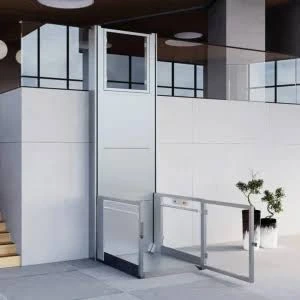
A vertical platform lift moves straight up and down between two levels.
It may be installed beside an entrance, next to a staircase, inside a villa, between split levels or in another suitable location.
Vertical platform lifts are useful when:
- There is enough floor and landing space.
- A direct vertical travel route is available.
- The user needs to remain in a wheelchair.
- A long ramp would occupy too much space.
- The property requires a permanent step-free access solution.
Inclined platform lift
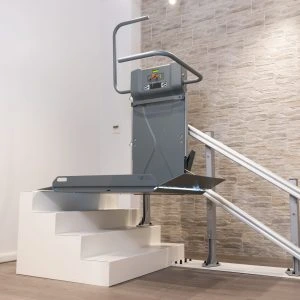
An inclined platform lift travels along a rail that follows the staircase.
The user rolls onto the platform in a wheelchair, secures the safety barriers and travels along the stairs without leaving the wheelchair.
Inclined platform lifts are available for straight staircases, while specialised models can accommodate curved or more complex staircases.
Who is a platform lift best for?
A platform lift may be suitable for:
- Full-time wheelchair users.
- Powered-wheelchair or mobility-scooter users.
- People who cannot transfer safely to a seated stair lift.
- Users who want to move independently between levels.
- Families planning for long-term wheelchair accessibility.
- Clinics, schools, mosques, offices and commercial buildings.
- Villa entrances and split-level properties.
- Properties where a compliant ramp would require too much horizontal space.
What Are the Main Differences Between a Stair Lift and a Platform Lift?
1. Transfer ability
Transfer ability is usually the most important difference.
A seated stair lift requires the user to move from a wheelchair, walking frame or standing position onto the lift seat. The user must then transfer again after reaching the opposite landing.
A platform lift normally allows the person to remain in the wheelchair or mobility scooter throughout the journey.
Even when a person can transfer today, families should consider whether transfers could become more difficult in the future.
2. Wheelchair access
A standard stair lift does not transport a wheelchair.
A platform lift is designed to accommodate a wheelchair, subject to its platform dimensions and approved weight capacity.
Before choosing a platform lift, check the combined weight of:
- The user.
- The wheelchair or mobility scooter.
- Any medical equipment.
- A caregiver, when the selected platform allows accompanied travel.
3. Staircase and floor space
Stair lifts are normally more compact. Many have folding seats, armrests and footrests that reduce the space they occupy when not in use.
An inclined platform lift needs a wider staircase because the open platform must travel safely without blocking surrounding walls, rails or other obstructions.
A vertical platform lift requires clear floor space at the lower and upper landings, but it does not always need to occupy the staircase itself.
4. Installation requirements
A standard straight stair lift usually requires less customisation and structural preparation than a curved stair lift or platform lift.
Platform-lift installation requirements depend on:
- Whether the lift is vertical or inclined.
- The height being overcome.
- Platform and landing dimensions.
- Door or gate configuration.
- Floor condition.
- Available electrical supply.
- Indoor or outdoor location.
- Whether a pit, ramp or supporting structure is required.
A professional assessment should be completed before selecting the model or confirming an installation price.
5. Straight and curved staircases
Both seated stair lifts and inclined platform lifts can be designed for straight staircases.
Curved staircases normally require custom rails and more detailed measurements. This applies to both curved chair stair lifts and curved inclined platform lifts.
For properties with complex staircases, a vertical platform lift installed in another suitable location may sometimes be more practical than following the full shape of the stairs.
6. Independence
A stair lift can provide excellent independence for someone who can sit, operate the controls and transfer safely.
However, a wheelchair user who requires assistance with each transfer may still depend on a caregiver at both ends of the staircase.
A platform lift can offer greater independence because the user can remain in the wheelchair during the journey.
The user’s ability to approach the lift, open the gate, operate the controls and exit safely should still be assessed.
7. Cost
A seated stair lift is generally less expensive than a platform lift, particularly when installed on a simple straight staircase.
A curved stair lift normally costs more because its rail must be manufactured for the staircase.
Platform-lift prices depend on the lift type, travel height, platform size, gates, finishes, site preparation and installation complexity.
Gilani Mobility’s current platform-lift range is generally priced from approximately AED 50,000, with larger, premium or more complex installations potentially reaching AED 200,000. Prices and product availability can change, so customers should request an itemised quotation after a site assessment.
The least expensive option is not always the most suitable long-term option. Transfer assistance, a second wheelchair, future modifications and caregiver requirements should also be considered.
8. Indoor and outdoor use
Both stair lifts and platform lifts are available for indoor and outdoor applications.
Outdoor installations in Dubai and across the UAE require particular attention to:
- High summer temperatures.
- Direct sunlight.
- Dust and sand.
- Humidity.
- Water exposure.
- Protective covers and finishes.
- Electrical-component protection.
- Cleaning and maintenance requirements.
An indoor model should not be installed outdoors unless the manufacturer has specifically approved it for exterior use.
9. Future mobility needs
A stair lift may be the right solution for a person who can transfer confidently and is expected to continue doing so.
A platform lift may provide better long-term accessibility when:
- The user already relies on a wheelchair.
- Transfers are becoming difficult.
- The condition affecting mobility is progressive.
- The property is being modified for ageing in place.
- Different wheelchair or scooter users may use the lift.
- The building requires wider accessibility for visitors, patients or customers.
Planning for future needs can reduce the possibility of replacing the lift later.
10. Residential and commercial use
Seated stair lifts are most commonly installed in private homes and villas for one primary user.
Platform lifts can be used in both residential and commercial environments. They may be more suitable for clinics, schools, offices, retail spaces, mosques and community buildings because they provide wheelchair access without requiring users to transfer.
Commercial projects may have additional design, approval, access and safety requirements. These should be reviewed with the project consultant, property manager and relevant authorities before installation.
Which Lift Is Better for Different Users?
| User or Property Requirement | Usually the Better Starting Option |
|---|---|
| Elderly user who can transfer safely | Seated stair lift |
| User with weak balance but good seated control | Seated stair lift |
| Temporary difficulty after surgery | Stair lift, depending on expected recovery and budget |
| Full-time wheelchair user | Platform lift |
| Powered-wheelchair user | Platform lift with suitable dimensions and capacity |
| User who cannot transfer independently | Platform lift |
| Narrow straight staircase | Compact straight stair lift |
| Curved staircase | Curved stair lift or custom inclined platform lift |
| Split-level villa | Vertical platform lift |
| Raised villa entrance | Outdoor vertical platform lift |
| Staircase must remain available to other family members | Foldable stair lift, foldable inclined platform lift or 2-in-1 staircase lift |
| Clinic, school or commercial building | Platform lift, subject to project requirements |
| Family planning for future wheelchair use | Platform lift may provide better long-term accessibility |
On mobile devices, swipe horizontally to view the full recommendation table.
What Safety Features Should You Compare?
Stair-lift safety features
Look for features such as:
- Seat belt.
- Swivel seat at the landing.
- Folding footrest and armrests.
- Obstruction sensors.
- Emergency stop.
- Easy-to-use controls.
- Remote call stations.
- Battery operation during a power interruption.
- Key control to prevent unauthorised use.
- Suitable seat size and weight capacity.
Platform-lift safety features
Depending on the model, important platform-lift features may include:
- Safety gates or barriers.
- Non-slip platform surface.
- Emergency stop.
- Obstruction detection.
- Safety edges or protective underpan.
- Controlled entry and exit.
- Battery-powered emergency lowering.
- Manual emergency procedures.
- Alarm or communication system.
- Suitable platform dimensions.
- Approved load capacity.
Safety features vary between products. Ask the supplier to demonstrate the controls, emergency procedures and safe entry and exit before handover.
Questions to Ask Before Choosing a Lift
A proper home or building assessment should answer the following questions:
- Can the user transfer to a stair-lift seat safely?
- Will the user need to remain in a wheelchair?
- Is the staircase straight, curved or spiral?
- How wide is the staircase?
- Is there enough landing space?
- Could a vertical platform lift be installed beside the stairs?
- Is the installation indoors or outdoors?
- What is the combined user and mobility-device weight?
- Will a caregiver travel with the user?
- What electrical or structural preparation is required?
- What warranty is included?
- Are extended-warranty options available?
- Who provides repairs and maintenance in the UAE?
- Are replacement batteries and spare parts available?
- How may the user’s mobility needs change in the future?
Platform-Lift and Stair-Lift Options Available from Gilani Mobility
The right model depends on the user, staircase and property. Examples of available solutions include:
For a simple straight staircase
A straight seated stair lift may be suitable for a user who can transfer safely and wants a compact solution.
Gilani Mobility offers straight stair-lift options with features such as folding seats, swivel seating, safety sensors, battery operation and easy controls, depending on the selected model.
For curved stairs
A curved stair lift follows bends, turns and landings using a rail manufactured for the staircase.
A custom inclined platform lift may also be considered when wheelchair access is required.
For wheelchair access along a staircase
Inclined platform lifts such as the LOGIC, NEXT, SLIM X or SLIM range may be considered, depending on whether the staircase is straight or curved and whether sufficient width and landing space are available.
For a villa entrance or split-level floor
A vertical platform lift such as Easylift or Sigma may provide wheelchair access without following the staircase.
Easylift is available in multiple configurations and can be considered for indoor or outdoor installations, subject to site conditions and final product specifications.
For a premium villa or interior
EleNor by Liftup is a customisable vertical platform lift designed for residential and commercial environments. Available configurations can support lifting heights from approximately 1,150 to 3,000 millimetres and capacities of up to 400 kilograms.
When the staircase must remain fully usable
FlexStep combines a staircase and platform lift within the same area. It functions as regular stairs when the lift is not required and transforms into a platform for wheelchair access.
All model recommendations remain subject to measurements, product specifications, user needs and site assessment.
Why a Professional Assessment Matters
Choosing a lift from photographs or staircase width alone can lead to the wrong recommendation.
A professional assessment should evaluate:
- The user’s ability to sit, stand and transfer.
- Wheelchair or scooter measurements.
- User and equipment weight.
- Staircase dimensions.
- Upper and lower landing clearances.
- Doors, walls and handrails.
- Available installation route.
- Electrical requirements.
- Indoor or outdoor exposure.
- Caregiver involvement.
- Emergency access.
- Future mobility needs.
The assessment should result in a written recommendation and itemised quotation explaining the product, installation requirements, warranty and ongoing service.
Why Choose Gilani Mobility for Stair Lifts and Platform Lifts?
Gilani Mobility provides home accessibility solutions in Dubai and across all seven UAE emirates.
Customers can receive support with:
- Staircase and property assessment.
- Straight, curved and outdoor stair lifts.
- Vertical and inclined platform lifts.
- Wheelchair-access solutions.
- Product selection and measurements.
- Professional installation planning.
- Manufacturer warranty.
- Extended-warranty options on selected products.
- Home callout support.
- Maintenance guidance.
- Replacement batteries and spare-parts support.
- Residential and commercial accessibility projects.
Gilani Mobility has operated in the UAE since 2022 and forms part of the Gilani Engineering group, which was established in Australia in 2011.
Frequently Asked Questions
What is the main difference between a stair lift and a platform lift?
A stair lift carries a person on a seat attached to a staircase rail. A platform lift carries the user on a platform and can normally accommodate a wheelchair. A stair lift usually requires the user to transfer, while a platform lift allows the user to remain in the wheelchair.
Can a wheelchair user use a stair lift?
A wheelchair user can use a seated stair lift when they can transfer safely from the wheelchair to the lift seat. The stair lift will not carry the wheelchair, so another wheelchair or mobility aid may be needed on the opposite floor. Users who cannot transfer safely should consider a platform lift.
Which takes up less space: a stair lift or a platform lift?
A seated stair lift generally takes up less space. Its chair, arms and footrest can often be folded when not in use. An inclined platform lift requires more staircase width, while a vertical platform lift needs sufficient floor and landing space.
Is a stair lift cheaper than a platform lift?
A standard straight stair lift is usually less expensive than a platform lift. Curved stair lifts cost more because their rails require custom manufacturing. Platform-lift prices vary considerably according to travel height, lift type, platform size, finishes and installation requirements.
Which option is better for an elderly person?
A stair lift may be suitable when the elderly user can sit, operate the controls and transfer safely. When transfers are unsafe, painful or likely to become more difficult, a platform lift may be the more appropriate long-term solution.
Can platform lifts carry powered wheelchairs?
Many platform lifts can carry powered wheelchairs, provided the wheelchair fits within the platform and the combined weight remains below the approved capacity. The wheelchair dimensions, turning space and total weight should be checked during the assessment.
Can stair lifts and platform lifts work during a power outage?
Some stair lifts operate using rechargeable batteries and can continue making a limited number of trips during a power interruption. Platform lifts may include battery lowering or emergency backup systems. The exact capability depends on the selected model and battery condition.
Can a stair lift or platform lift be installed outdoors in Dubai?
Yes, selected outdoor-rated stair lifts and platform lifts can be installed outside. The model should be suitable for UAE conditions, including heat, sunlight, humidity and dust. Outdoor installations also require appropriate electrical protection and regular maintenance.
Does a platform lift require major construction?
Not always. Some modular platform lifts can be installed with minimal structural preparation and without a deep pit or machine room. Other installations may require a small pit, supporting structure, gates or floor preparation. The requirements depend on the model and property.
How do I know which lift is right for my home?
Start with the user’s transfer ability and mobility device. Then assess the staircase, available space, travel height, indoor or outdoor location, weight capacity, budget and future mobility needs. A professional site assessment is the safest way to choose the correct solution.
Book a Stair-Lift or Platform-Lift Assessment in the UAE
The correct lift should match both the user and the property.
A stair lift may be the practical choice for someone who can transfer safely and needs a compact chair-based solution. A platform lift is normally better for a wheelchair user who needs to move between levels without transferring.
Gilani Mobility provides stair-lift and platform-lift assessments in Dubai, Abu Dhabi, Sharjah, Ajman, Ras Al Khaimah, Fujairah and Umm Al Quwain.
Contact Gilani Mobility to arrange an assessment and receive a recommendation covering the suitable lift type, installation requirements, safety features, warranty and after-sales support.