
















Table of Contents
ToggleEverything you need to know about wheelchair platform lifts, vertical platform lifts, and how they transform accessibility for homes, villas, offices, and commercial buildings across Dubai, Saudi Arabia, Qatar, Kuwait, Bahrain, and Oman.
What is a platform lift?
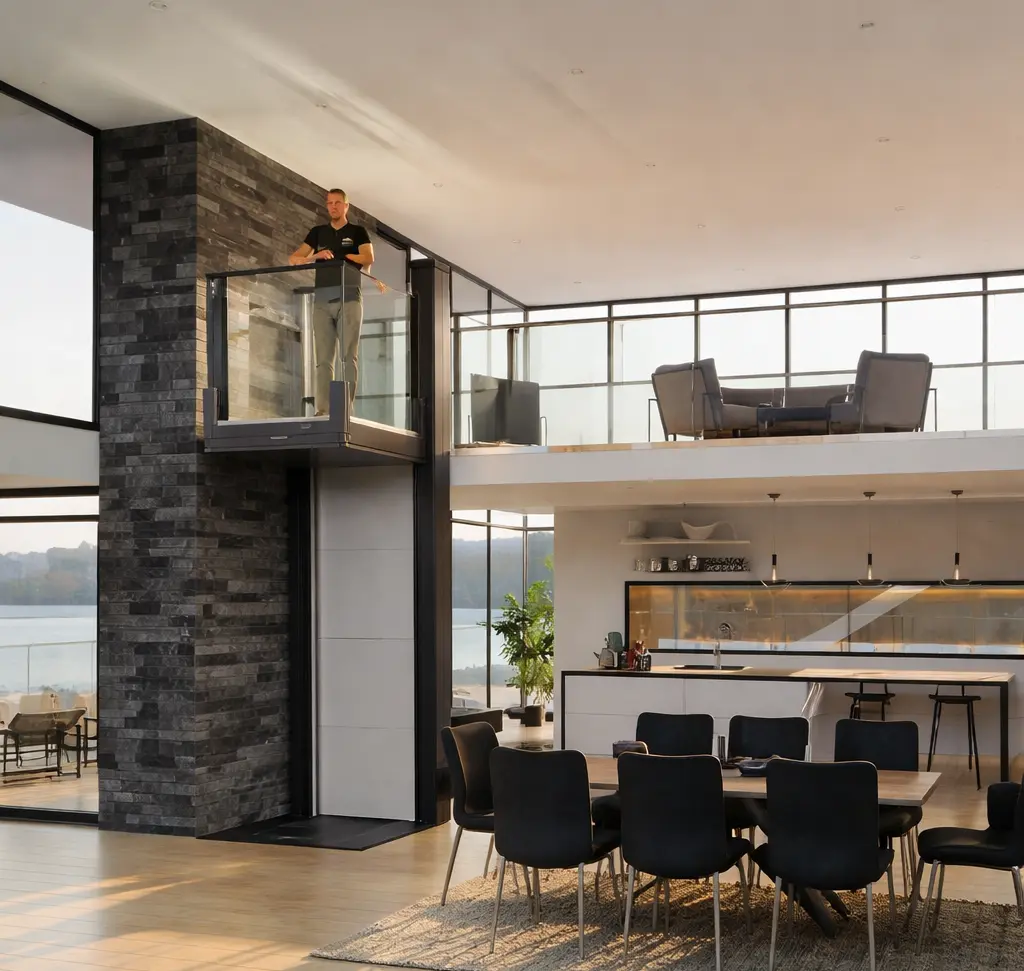
A platform lift – also called a wheelchair lift or vertical platform lift (VPL) – is a compact, electrically powered lifting system designed to carry people, including wheelchair users, between different floor levels in a building. Unlike conventional passenger elevators, platform lifts do not require a machine room, deep pits, or extensive structural work. They mount directly onto finished floors and can be operational in a fraction of the time it takes to install a traditional lift.
Across the GCC – including the UAE, Saudi Arabia, Qatar, Kuwait, Bahrain, and Oman – platform lifts are rapidly becoming the preferred accessibility solution for villas, duplexes, clinics, schools, mosques, hotels, and offices. They are especially practical for existing buildings where full elevator installation is either too costly or architecturally challenging.
Platform lifts are available in two main types: Vertical Platform Lifts (VPL) for level-to-level vertical movement, and Inclined Platform Lifts (IPL) for staircase access – both designed to safely carry wheelchair users and people with limited mobility.
Top 10 Benefits of Platform Lifts
Whether you are a homeowner in Riyadh looking after an elderly parent, a facility manager in Doha ensuring accessibility compliance, or a villa owner in Muscat planning a home upgrade — the benefits of a platform lift are significant and lasting.
1. Restores Independence
Wheelchair users and seniors can move between floors without assistance, significantly improving day-to-day freedom and confidence at home or work.
2. Space-Efficient Design
Compact footprint means platform lifts fit in tight villa stairwells, narrow corridors, and outdoor facades without requiring major architectural redesign – ideal for the diverse building styles found across the GCC.
3. Advanced Safety Systems
Emergency stop buttons, anti-slip platform surfaces, safety gate interlocks, guardrails, and battery backup during power cuts – all standard in quality models.
4. No Heavy Civil Works Needed
Most platform lifts require no pit excavation, no machine room, and no masonry work – they stand directly on finished floors, saving time and renovation costs.
5. Cost-Effective Accessibility
Platform lifts cost significantly less than conventional passenger elevators – both in installation and ongoing maintenance – making them ideal for homes, villas, and SMEs throughout the GCC.
6. Energy Efficient
Operating on single-phase power and low-energy motors, platform lifts consume far less electricity than standard elevators – reducing your building’s running costs.
7. Indoor & Outdoor Versatility
Quality platform lifts are rated for both indoor and outdoor installation, making them suitable for villas with elevated entrances, garden steps, commercial facades, and outdoor public spaces across the region.
8. Increases Property Value
An accessible property is more valuable and marketable. Platform lifts are a lasting home modification that attracts buyers and tenants with accessibility needs across all GCC real estate markets.
9. GCC Regulatory Compliance
Installing a platform lift helps commercial buildings and public spaces meet accessibility requirements for People of Determination and People with Disabilities under the laws and guidelines of each GCC country.
10. Fully Customizable
Platform lifts can be tailored in platform size, load capacity, door configuration, colors, and finishes – seamlessly matching the aesthetics of your home or office interior, whether in Dubai, Riyadh, Doha, Kuwait City, Manama, or Muscat.
Types of Platform Lifts Available in the GCC
At Gilani Mobility, we supply and install several categories of platform lift, each suited to different architectural environments and user needs across the GCC.
1. Vertical Platform Lift (VPL)
The most common type. Provides straight vertical movement between two or more floors. Ideal for homes, villas, clinics, and small offices. Models like the EleNor by Liftup offer lifting heights of 1,150 mm to 3,000 mm and a 400 kg capacity – enough for a wheelchair user with a carer. Certified to EN81-41 and ASME A18.1 international standards.
2. Inclined Platform Lift (IPL)
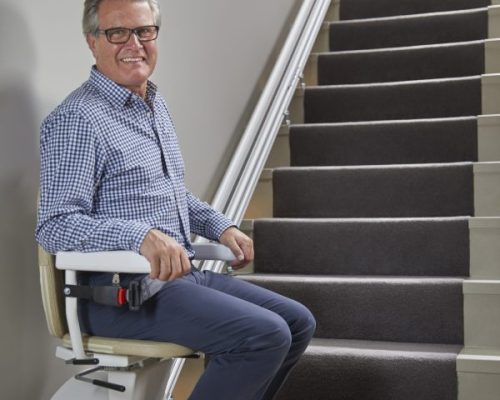
Travels along a staircase rail, folding away when not in use. Suitable for straight or curved staircases both indoors and outdoors. A practical solution for buildings where installing a vertical lift is not feasible. Capable of carrying up to 300 kg, covering stairs up to 10 metres in length.
3. Hidden (Floor-Level) Platform Lift
Recessed flush with the floor when lowered, making it virtually invisible in high-end interiors. Ideal for luxury villas, heritage buildings, mosques, and upscale commercial spaces where aesthetics cannot be compromised. The HDN Hidden Lift by Liftup is a popular choice across the GCC’s premium residential and hospitality market.
4. Compact Stairlift-Platform Hybrid
A dual-function 2-in-1 solution (such as the FlexStep) that acts as normal stairs when not in use and transforms into a lift platform on demand. Plug-and-play installation with no structural changes required. Particularly popular in GCC schools, clinics, retail spaces, and mosques.
Platform Lift for Home Use in the GCC
For families living in Dubai villas, Riyadh compounds, Doha townhouses, or Muscat residences, a home platform lift is the most practical accessibility upgrade available. Many GCC homes were designed without elevators, making multi-floor movement a serious challenge for elderly residents and wheelchair users.
Installation time: under 1 day · Max load: 400 kg (wheelchair + carer) · Near-silent operation: under 60 dB · Max vertical travel height: 3,000 mm
Key Home Use Cases
Elderly parents – Restore safe floor access for seniors who can no longer safely use stairs in your villa or family home.
Post-surgery recovery – Temporary or permanent accessibility support for family members recovering from surgery or injury.
Wheelchair users – Enable wheelchair users to move independently between bedrooms, living areas, and ground floors without assistance.
Multi-generational homes – Future-proof your home to accommodate multiple generations with varying mobility needs, a common household structure across the GCC.
Elevated entrances – Solve the common GCC villa problem of raised front entrances with a compact outdoor platform lift.
Garage & basement access – Provide safe, smooth access to underground garages and basement floors without the need for ramps.
Platform Lift for Office & Commercial Buildings
In commercial settings across the GCC, platform lifts serve a dual role: they improve accessibility for people with disabilities and they signal corporate responsibility and inclusivity. With accessibility regulations evolving across Saudi Arabia, Qatar, Kuwait, Bahrain, Oman, and the UAE – mandating accessible routes in new and renovated public spaces – installing a compliant platform lift is both a legal requirement and a sound business investment.
Commercial Applications Across the GCC
Hotels & resorts – Ensure guests with mobility challenges have full access to all amenities and floors across the region’s world-class hospitality properties.
Medical clinics & hospitals – Patient-first design — provide safe, smooth access for patients in wheelchairs or on mobility scooters across private and public healthcare facilities.
Schools & universities – Meet inclusive education requirements and provide equal access for students with disabilities across GCC educational institutions.
Retail & shopping – Connect split-level retail floors and improve the shopping experience for all customers across malls, boutiques, and high-street stores.
Mosques & community centers – Enable worshippers and community members of all abilities to participate fully in religious and social life — a particularly important consideration across the GCC.
Office buildings – Comply with workplace accessibility standards across all GCC countries and create an inclusive environment for staff and visitors.
Government & public buildings – Support national accessibility mandates and create public spaces that are truly open to everyone.
Governments across the GCC are strengthening accessibility standards for public and commercial buildings. Businesses that proactively invest in platform lifts avoid compliance penalties while enhancing their brand reputation and expanding their customer base across the region.
Wheelchair Platform Lift: Who Needs One?
A wheelchair platform lift is designed specifically for individuals who use manual or electric wheelchairs, mobility scooters, or walking frames. Unlike a stairlift, there is no need to transfer out of the wheelchair – the entire chair moves with the user, making every journey safer and more dignified.
The following groups benefit most from a wheelchair platform lift:
- People with physical disabilities or paralysis using a wheelchair full-time
- Elderly individuals with reduced leg strength or balance issues
- Post-operative patients recovering from hip, knee, or spinal surgery
- Children with mobility impairments requiring accessible home environments
- Individuals with neurological conditions such as MS, Parkinson’s, or cerebral palsy
- Anyone caring for a family member who needs assisted vertical transport
Platform Lift vs. Traditional Elevator: Which Is Right for You?
Many property owners across the GCC are unsure whether to choose a platform lift or install a conventional passenger elevator. The key differences are as follows:
Installation time — Platform lift: less than 1 day (most models). Traditional elevator: weeks to months.
Civil works required — Platform lift: minimal, no pit or machine room. Traditional elevator: significant structural changes.
Space requirement — Platform lift: very compact. Traditional elevator: requires a dedicated shaft.
Cost — Platform lift: significantly lower. Traditional elevator: high capital investment.
Energy consumption — Platform lift: low, single-phase power. Traditional elevator: higher energy demand.
Travel height — Platform lift: short to medium (up to ~3 m VPL). Traditional elevator: full multi-storey.
Maintenance — Platform lift: simple, lower cost. Traditional elevator: complex, regulated inspection.
Wheelchair suitability — Platform lift: designed specifically for wheelchair users. Traditional elevator: can accommodate, but not optimized for wheelchair access.
Customization — Platform lift: high, 1,000+ configurations available. Traditional elevator: limited by shaft dimensions.
Best for — Platform lift: homes, villas, small commercial, mosques, clinics. Traditional elevator: large multi-floor commercial and residential towers.
Platform Lift Installation Across the GCC
One of the most common concerns property owners raise is whether installation will disrupt their home or business. At Gilani Mobility, our experienced installation team completes most platform lift installations with minimal disruption – typically within a single working day for standard VPL systems.
We serve clients across all six GCC countries: the UAE, Saudi Arabia, Qatar, Kuwait, Bahrain, and Oman, with professional installation, warranty support, and after-sales service available throughout the region.
Our Installation Process
- Free site assessment — Our team visits your property to assess the space, measure access points, and recommend the most suitable lift model for your specific architectural layout and accessibility needs.
- Customized solution design — We configure the lift to your exact specifications — platform size, lifting height, door orientation, color, and finish — ensuring it integrates seamlessly with your interior or exterior environment.
- Professional installation — Our certified engineers install the system on finished floors with no masonry or heavy civil works, minimizing disruption to your household or business operations.
- Testing & user training — Every installation is fully tested before handover. We train users and caregivers on safe operation, including emergency procedures and daily use best practices.
- Warranty & after-sales support — All systems come with manufacturer-backed warranties. Our GCC-wide service team provides ongoing maintenance, spare parts, and technical support across all countries we operate in.
GCC Regulations & Accessibility Compliance
Across the GCC, governments are placing increasing emphasis on accessibility and inclusivity for people with disabilities. Each country has developed or is developing regulatory frameworks that require accessible routes, compliant infrastructure, and safe evacuation systems in new and renovated public buildings.
UAE — Dubai Municipality guidelines require accessible routes, compliant signage, and evacuation readiness for People of Determination in public and commercial buildings.
Saudi Arabia — Vision 2030 includes a strong focus on social inclusion and accessibility. The Saudi Building Code and disability regulations require accessible design in new construction and major renovations.
Qatar — Qatar’s national building standards include accessibility requirements for public buildings, sports venues, and commercial facilities.
Kuwait — Kuwait’s national accessibility standards require that public buildings and commercial facilities provide accessible routes and facilities for people with disabilities.
Bahrain — Bahrain’s National Plan for People with Disabilities and building regulations mandate accessible design across public and commercial buildings.
Oman — Oman’s accessibility framework requires that public and commercial buildings provide accessible routes and facilities in line with international standards.
Platform lifts that meet international safety standards such as EN81-41 and ASME A18.1 are widely accepted across the GCC when properly integrated and documented. All platform lift models supplied by Gilani Mobility are certified to recognized international safety standards and can be documented for compliance requirements in any GCC country.
Key compliance requirements for commercial installations typically include obtaining appropriate permits, providing compliance certificates, ensuring fire and evacuation readiness, and maintaining documented service plans. Gilani Mobility supports clients through every step of this process, regardless of which GCC country they are based in.
Frequently Asked Questions
What is a platform lift and how does it work?
A platform lift is a mechanical system that raises a person — in a wheelchair or standing — between floor levels using an electric motor and a vertical or inclined guide rail. The user rolls or steps onto the platform, operates it via push-button or remote control, and the platform travels smoothly to the next level.
How much does a platform lift cost in the GCC?
Platform lift cost varies based on model, lifting height, platform size, indoor vs. outdoor installation, and customization requirements. Because every site is different, Gilani Mobility offers a free consultation and site assessment to provide an accurate quote for your specific requirements, wherever you are in the GCC.
Can a platform lift be installed in an existing villa without major renovation?
Yes. The majority of platform lifts do not require pit excavation or a machine room, and they stand directly on finished floors. This makes them ideal for existing villas, family homes, and duplex properties across all GCC countries without the need for costly structural modifications.
What is the difference between a vertical platform lift and an inclined platform lift?
A vertical platform lift (VPL) moves straight up and down between floor levels and requires its own dedicated installation space. An inclined platform lift (IPL) travels along a staircase rail — ideal when space constraints make a VPL impractical. Both carry wheelchair users safely; the right choice depends on your staircase layout and the space available.
Is a platform lift safe for elderly users?
Absolutely. Quality platform lifts include non-slip platform surfaces, safety gate interlocks that prevent movement until gates are fully secured, emergency stop buttons, guardrails, and battery backup for power outages. Models like the EleNor by Liftup operate near-silently at under 60 dB and include a patented safety underpan with emergency stop.
Do platform lifts require regular maintenance?
Like any mechanical system, periodic maintenance is recommended to ensure long-term safety and performance. Gilani Mobility provides after-sales maintenance support, spare parts availability, and technical service across all GCC countries to keep your lift operating at its best.
Does Gilani Mobility install platform lifts outside the UAE?
Yes. Gilani Mobility supplies and installs platform lifts across all GCC countries — the UAE, Saudi Arabia, Qatar, Kuwait, Bahrain, and Oman — with a dedicated regional team for installation and after-sales support.
What types of buildings are platform lifts suitable for in the GCC?
Platform lifts are suitable for a wide range of properties across the GCC, including private villas and family homes, apartment duplexes, medical clinics and hospitals, schools and universities, mosques and community centers, hotels and resorts, retail and commercial spaces, and government and public buildings.
Ready to make your space fully accessible? Speak to our accessibility experts for a free site assessment and personalized platform lift recommendation anywhere in the GCC.
Visit: gilanimobility.ae | Call: +971 4 881 8426
